TL;DR
A manifesto published November 16 by European game union members urges workers to avoid generative AI where possible, employers to avoid it entirely, and regulators to require consent and fair compensation for training data. Its claims about job losses and working conditions reflect the unions’ position; the number of workers represented and any studio response remain unclear.
Members of six European game unions published a generative AI manifesto on November 16, urging studios to avoid the technology and calling for rules requiring consent and fair compensation when creative work is used to train AI systems. The document matters to game workers and studios because it covers AI use throughout production, including early concepts and prototyping, not just material that appears in a finished game.

Play games on Amazon Luna for your game nights, included with Prime
- A rotating selection of games, no download needed
- Play on TV, laptop or phone
- Fast, free delivery for your gear, too
The manifesto, titled On Generative AI Usage in the Games Industry, was published on the website of IWGB Game Workers. Its listed contributors include members of the UK branch, Game Workers Unite Ireland, Spain’s CSVI and the FIOM-CGIL Milan Work Council. Rock Paper Shotgun and Kotaku also identify France’s STJV and Germany’s GDRT among the groups involved. The source material does not say how many workers these unions represent.
For workers, the authors recommend avoiding genAI services where possible, organising, and negotiating agreements with employers. For studios, they call for avoiding genAI entirely, say no worker should be required to use it, and ask that any unavoidable use be labelled precisely. Their recommendations cover art, sound, code and dialogue, as well as behind-the-scenes work such as concept art, reference materials and pre-translations.
The authors also ask players to support games made without genAI and urge regulators to prohibit use of people’s work in AI training datasets without consent and fair compensation. They say workers should be able to withdraw their work from such datasets. These are demands in a union manifesto, not rules that have been adopted. The text’s central principle is that workers should decide when, where and how the tools are used.
Pressure on Studio AI Policies
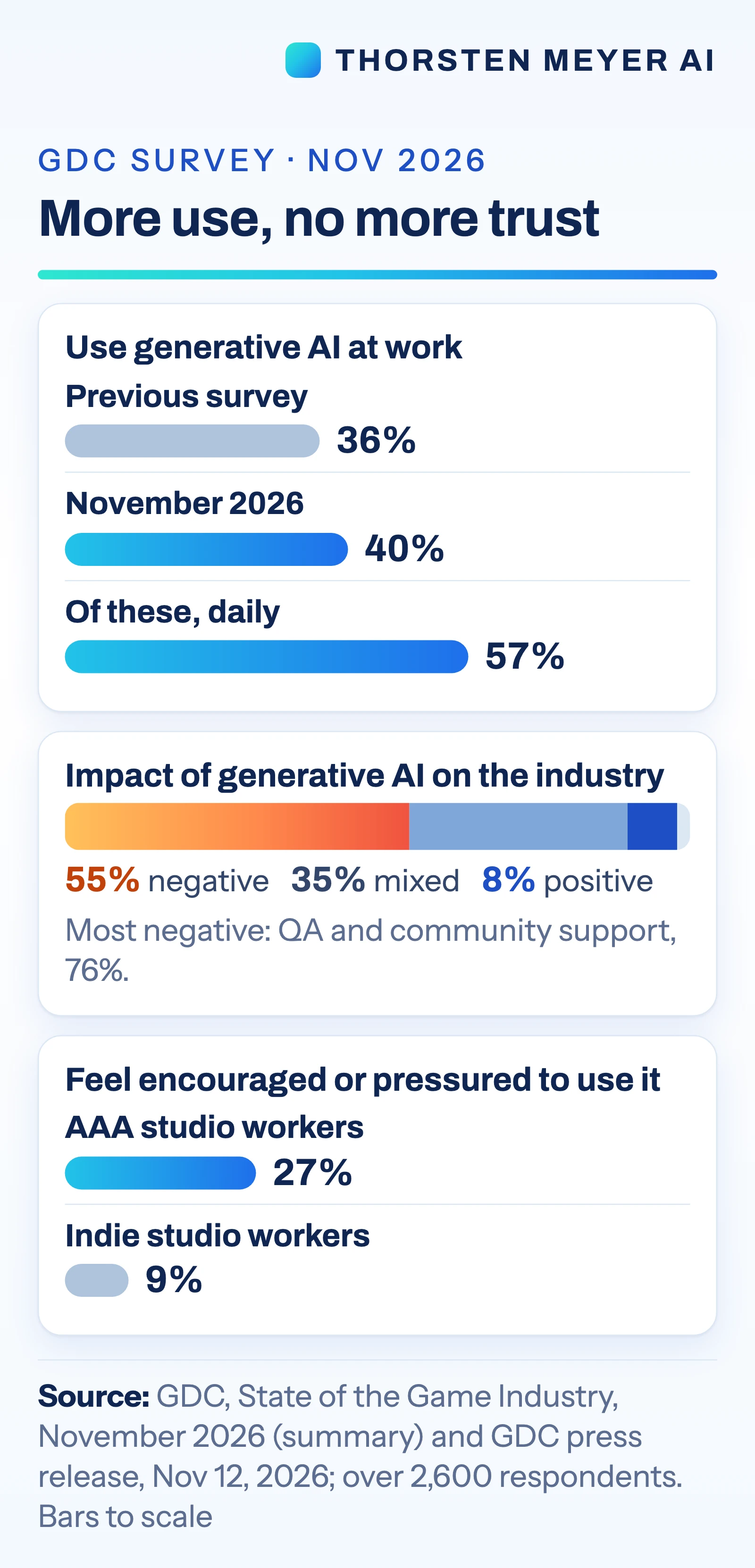
The manifesto puts a clear set of demands on studios at a time when AI use is already part of many game professionals’ work. The Game Developers Conference’s State of the Game Industry survey, published November 12, found that 40% of respondents use genAI at work, up from 36% in the prior survey. The same survey found that 55% believed the technology was having a negative impact on the industry. Those figures describe survey respondents; they do not establish how every studio or worker views AI.
If adopted, the unions’ requested policies would affect more than visible AI-generated assets. A studio could face scrutiny under the proposed approach for using genAI during prototyping or preparing internal materials, even if it removed AI-generated work before release. The demands could also shape workplace negotiations about whether AI use is optional, how it is disclosed, and who is held responsible for errors.
For players, the call to favour games made without genAI proposes a way to influence studio choices through purchases and public feedback. Whether that pressure changes production practices is not yet clear. The manifesto does, however, make the unions’ position explicit: decisions about AI involve working conditions and ownership concerns as well as production tools.
Popular right now

KitchenAid Artisan Mini Tilt-Head Stand Mixer, 3.5 Quart, Aqua Sky Blue

Vitamix VX1 Professional-Grade Blender, 64 oz, Black

De'Longhi Rivelia Automatic Espresso Machine with Milk Frother
As an affiliate, we earn on qualifying purchases.
Industry Debate Around AI
The manifesto appeared amid debate over both AI adoption and employment in games. The GDC survey reported that 34% of respondents had been laid off in the previous two years. That figure does not show that AI caused those layoffs, and the survey does not establish a link between the two developments.
Several other statements have highlighted differing views. A group of Independent Games Festival jurors said days before the manifesto that they would not vote for games using genAI “in any capacity.” The studio behind Big Walk, meanwhile, said large language models touched “well under 0.1%” of its code. The percentage is the studio’s account of its own project, not an industry-wide measure.
Video Games Europe, the European industry trade body, wrote in 2024 that genAI was “widely expected to take video game development to the next level” and argued against AI labels in games. On November 12, Xbox CEO Asha Sharma wrote that “A small team will be able to build worlds that today demand hundreds of developers,” without naming AI. These statements show different views of technology and production; neither is a direct response to the unions’ November manifesto.
““Games are best made by people.””
— The manifesto’s authors
Representation and Studio Responses
The unions do not state how many workers they represent, and the source material reports no public response from a studio or industry trade body to the manifesto by the time of writing. It is also unclear whether any employer will change its AI policies or negotiate agreements in response.
The manifesto argues that genAI is replacing workers, contributing to fewer junior roles and worsening working conditions. These are the authors’ claims; the cited survey figures on AI use and layoffs do not, by themselves, establish that AI caused job losses. Legal questions around the use of copyrighted work in training datasets are also unsettled in the source material. No specific regulatory proposal or enacted rule is identified.
From Demands to Negotiations
The next developments to watch are whether studios and unions take the manifesto’s recommendations into workplace negotiations, and whether regulators address consent, compensation and workers’ ability to withdraw material from training datasets. The document calls for organising and company agreements but names no negotiation timetable, government action or studio commitment.
Any subsequent studio policy changes or public responses would show whether the manifesto has affected practice. Until then, the text records the participating unions’ demands and position, while the scale of their influence and the industry’s response remain open.
Key Questions
What are European game unions asking studios to do about generative AI?
The manifesto urges employers to avoid genAI, says workers should not be required to use it, and calls for precise labelling of any use that cannot be avoided.
Does the manifesto cover AI used during development but not in the finished game?
Yes. It discusses behind-the-scenes uses such as early concept art, reference materials and pre-translations, as well as assets that players may see.
How common is generative AI use among game professionals?
The GDC’s November 12, 2026 survey found that 40% of respondents used genAI at work, up from 36% in the prior survey. The survey also found that 55% saw a negative impact on the industry.
Have studios agreed to follow the manifesto?
No agreement is reported in the source material. It says no public studio or trade body response to the manifesto was found by the time of writing.
Does the layoff data show that AI is causing job losses?
No. The GDC survey reported that 34% of respondents had been laid off in the previous two years, but that figure does not establish that AI caused those layoffs.
Source: Thorsten Meyer AI