
TL;DR

Play games on Amazon Luna for your game nights, included with Prime
- A rotating selection of games, no download needed
- Play on TV, laptop or phone
- Fast, free delivery for your gear, too
This article examines the technical artistry of Sega CD’s Silpheed, highlighting its innovative FMV format and engineering. Confirmed details include its unique animation approach and hardware integration; some technical specifics remain unconfirmed. The story underscores the game’s lasting influence on gaming art and system design.
Sega CD’s Silpheed is recognized for its groundbreaking combination of artistic quality and technical innovation, making it a standout title for the platform. This analysis details how the game achieved remarkable animation within hardware constraints, and why this matters for both gaming history and technical design.
Developed by Game Arts, Silpheed on the Sega CD employed a unique FMV format that blended real-time rendering with pre-calculated animation, creating near-fullscreen cutscenes with limited hardware. The game utilized a 12.5MHz Motorola 68000 CPU, 16 colors, and modest bandwidth, yet achieved impressive visual effects that continue to impress modern observers.
Reverse engineering efforts reveal that Silpheed’s FMV relied on highly optimized data compression and clever use of system architecture, including double-buffering for smooth animation. The game’s developers deliberately designed within system constraints, favoring flat-shaded polygons and minimal dithering, which contributed to its distinctive aesthetic.
While some technical details, such as the exact compression algorithms, remain unconfirmed, the game’s innovative approach has been praised for pushing the boundaries of what was thought possible on the Sega CD platform, influencing future FMV and graphics techniques.
Why Silpheed’s Technical Artistry Matters Today
Silpheed exemplifies how creative engineering can overcome hardware limitations to produce compelling visual storytelling. Its techniques prefigured modern approaches to real-time rendering and data optimization, making it a case study in innovative game design. This legacy underscores the importance of technical ingenuity in advancing gaming art, inspiring both developers and historians.
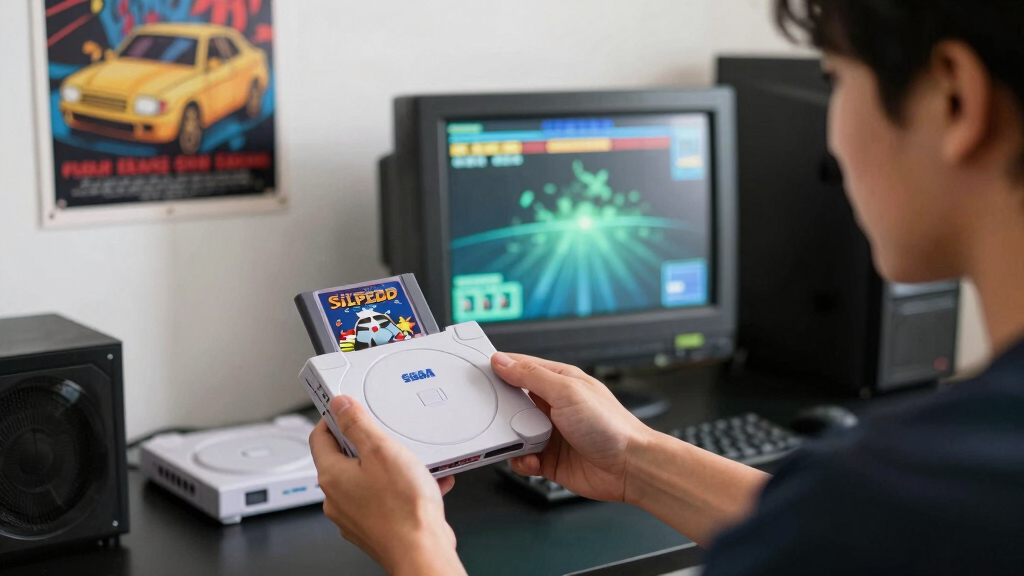
Sega CD Silpheed retro game cartridge
As an affiliate, we earn on qualifying purchases.
As an affiliate, we earn on qualifying purchases.
Historical and Technical Context of Silpheed’s Development
During the mid-90s, the Sega CD was notorious for its reliance on FMV, often resulting in low-quality, heavily compressed videos. Silpheed distinguished itself by adopting a different philosophy—prioritizing artistic intent and system-aware optimization over raw compression. Its development coincided with broader efforts to extract more visual fidelity from limited hardware, setting a benchmark for future titles.
Reverse engineering and technical analyses reveal that the game’s developers meticulously engineered the FMV format to fit within the system’s bandwidth and processing constraints, a feat that was both innovative and technically demanding at the time.
“Silpheed’s animation and FMV techniques were a remarkable achievement given the hardware limitations of the Sega CD, demonstrating a sophisticated understanding of both art and engineering.”
— Hacker News Contributor
As an affiliate, we earn on qualifying purchases.
Unconfirmed Technical Details and Ongoing Analysis
Some specifics about the exact compression algorithms and data handling techniques used in Silpheed’s FMV remain unconfirmed. While reverse engineering has provided insights, full technical documentation has not been publicly released, leaving certain aspects open to interpretation and further study.
As an affiliate, we earn on qualifying purchases.
Future Research and Potential Open-Source Tools
Ongoing efforts aim to fully decode Silpheed’s FMV format, with plans to publish open-source tools for analysis and emulation. Additionally, developers are exploring how these techniques can influence modern retro-style game projects and educational resources on hardware-aware programming.
As an affiliate, we earn on qualifying purchases.
Key Questions
How did Silpheed achieve its impressive FMV quality on limited hardware?
Through meticulous optimization, including minimal color use, flat shading, and custom compression techniques tailored to the Sega CD’s bandwidth and processing limits.
What makes Silpheed’s animation different from other FMV games of the era?
Instead of relying heavily on full-motion video, it used a hybrid approach of real-time rendering and pre-calculated animation, resulting in smoother visuals within system constraints.
Are there any existing tools to analyze or emulate Silpheed’s FMV format?
Reverse engineering efforts are ongoing, and some open-source tools are being developed, but no official or comprehensive solutions are yet publicly available.
Why is Silpheed still relevant for modern game developers?
It demonstrates how innovative system-aware design can push hardware limits, inspiring current developers to optimize creatively within constraints.
Will there be a remake or re-release of Silpheed with enhanced graphics?
There are no announced plans; however, its technical legacy continues to influence retro-inspired projects and academic studies.
Source: Hacker News
Halloween Picks
halloween
As an affiliate, we earn on qualifying purchases.