
If I were choosing among the best small form factor PC cases for Steam gaming, I would put the Fractal Design Ridge first because its console-style layout fits a TV setup while still making room for a real gaming GPU. The HYTE Revolt 3 is the better pick for players who move their PC between rooms or LAN nights, while the Fractal Design Terra is the premium choice when design matters as much as footprint. The main choice is not just size; it is whether you want couch-friendly placement, easier building, lower parts cost, or maximum portability. Smaller cases can force stricter GPU, CPU cooler, PSU, and airflow choices, so the best pick depends on the Steam library and hardware you plan to run. Read on for the full breakdown of where each case wins, where it gives something up, and which buyer should skip it.

Play games on Amazon Luna for your game nights, included with Prime
- A rotating selection of games, no download needed
- Play on TV, laptop or phone
- Fast, free delivery for your gear, too
Key Takeaways
- Fractal Design Ridge ranks first because it connects the SFF case problem directly to Steam couch gaming: slim placement, PCIe 4.0 riser support, included fans, and TV-friendly orientation.
- HYTE Revolt 3 beats smaller style-first cases for portability and easier parts planning, but its vertical industrial shape is less subtle in a living room.
- JONSBO/JONSPLUS Z20 is the value play because Micro-ATX and ATX PSU support can lower total build cost, though it is much larger than Terra, Ridge, and JOYJOM.
- Fractal Design Terra is the premium design pick, not the safest thermal pick; its small shell and walnut/aluminum finish look great, but cooler and GPU balancing matter more.
- The budget handle cases and JOYJOM Mini ITX reveal the same pattern: portability is easy to market, but riser version, airflow, documentation, and component clearance decide whether the build feels pleasant.
| HYTE Revolt 3 ITX Case – Metal, Black |  | Best Overall Portable ITX Pick | Motherboard Compatibility: Standard ITX | Panel Access: Removable external panels on all sides | USB-A Ports: 2 x USB 3.2 Gen 1 Type-A | VIEW LATEST PRICE | See Our Full Breakdown |
| JONSBO/JONSPLUS Z20 Black Micro-ATX Mini Tower PC Case with Detachable Carrying Handle |  | Best Value Flexibility | Motherboard Support: Micro-ATX and Mini-ITX | Case Type: Mini-tower | GPU Clearance: Up to 363mm | VIEW LATEST PRICE | See Our Full Breakdown |
| Fractal Design Terra Graphite Mini ITX Gaming Case with Walnut Front Panel and Anodized Aluminum |  | Best Premium Living Room Case | Motherboard Support: Mini ITX | Case Type: Mini-tower | GPU Support: Up to 322mm | VIEW LATEST PRICE | See Our Full Breakdown |
| Lian Li VECTOR V100 Mini PC Case with 4 x 120mm ARGB PWM Fans, Tempered Glass Panels – Black (V100RMIX) |  | Best Showcase Micro-ATX Pick | Form Factor: Micro-ATX | Motherboard Compatibility: mATX, no ATX support | Max GPU Length: 415mm | VIEW LATEST PRICE | See Our Full Breakdown |
| JOYJOM Mini ITX Aluminum PC Case with PCIe 3.0 Riser (Black) |  | Best Ultra-Compact Challenge Build | Capacity: 4.3L | Dimensions: 18.4 x 10.4 x 22.3 cm, or 7.3 x 4.1 x 8.8 inches | Motherboard Support: Standard ITX, 17 x 17 cm | VIEW LATEST PRICE | See Our Full Breakdown |
| Fractal Design Ridge Black m-ITX PC Gaming Case with PCIe 4.0 Riser and Fans |  | Best Living-Room Steam Build | Case Type: Small form factor gaming case | Motherboard Support: Mini-ITX | Color: Black | VIEW LATEST PRICE | See Our Full Breakdown |
| Mini ITX PC Case with Removable Handle – Black |  | Best Portable Steam Rig | Dimensions: 315 x 135 x 215 mm | Motherboard Support: Mini-ITX | Max CPU Cooler Height: 60 mm | VIEW LATEST PRICE | See Our Full Breakdown |
More Details on Our Top Picks
HYTE Revolt 3 ITX Case – Metal, Black
I rank HYTE Revolt 3 highest here because it balances Steam gaming portability, build access, and modern front I/O better than the more style-led Fractal Design Terra or the much tighter JOYJOM Mini ITX case. The removable panels give builders 360-degree access, which matters in an ITX layout where cable routing and cooler clearance can turn small upgrades into slow work. Compared with the JONSBO/JONSPLUS Z20, it is less flexible for large parts, but it is also more clearly aimed at a compact carry-friendly gaming setup. The tradeoff is component headroom: buyers planning oversized GPUs, big air coolers, or roomy cable channels may feel boxed in. I see this as the strongest all-rounder for a small Steam-focused PC that may move between desk, TV, and LAN bag.
Pros:- Carry handle makes it more portable than most compact gaming cases
- Removable panels on all sides make ITX building less cramped
- Front USB-C Gen 2 and dual USB-A ports suit modern peripherals
- Metal construction and 3-year warranty add confidence
Cons:- Tighter internal space limits larger GPU and cooling choices
- ITX-only motherboard support raises build cost versus Micro-ATX options
- No price range in the supplied data makes value harder to judge
Best for: Steam gamers building a portable Mini-ITX system for desk-to-TV use or occasional LAN travel.
Not ideal for: Buyers using oversized GPUs, tall coolers, or full-size layouts that need generous cable space.
- Motherboard Compatibility:Standard ITX
- Panel Access:Removable external panels on all sides
- USB-A Ports:2 x USB 3.2 Gen 1 Type-A
- USB-C Port:1 x USB-C Gen 2
- Audio:Headset combo jack
- Material:Metal
- Color:Black
- Warranty:3 years
Bottom line: This is my top pick for buyers who want a compact Steam gaming case that stays portable without becoming too punishing to build in.
JONSBO/JONSPLUS Z20 Black Micro-ATX Mini Tower PC Case with Detachable Carrying Handle
JONSBO/JONSPLUS Z20 earns its place as the practical value pick because it gives Steam gamers more hardware freedom than the HYTE Revolt 3 or Fractal Design Terra. Support for Micro-ATX boards, long GPUs, ATX or SFX power supplies, and a 240mm AIO means buyers can reuse cheaper mainstream parts instead of paying the ITX premium. That makes it better suited to a powerful library machine for 1440p play than the ultra-small JOYJOM Mini ITX case. The penalty is size and planning: at 14.56 inches deep, it is compact rather than tiny, and the bottom PSU layout can make cable work awkward. I would pick it when performance-per-dollar matters more than having the smallest possible footprint.
Pros:- Micro-ATX support can reduce total build cost
- 363mm GPU clearance suits many high-end gaming cards
- 240mm AIO and 160mm air cooler support improve cooling choices
- Detachable handle adds portability without forcing an ITX-only build
Cons:- Larger than the HYTE Revolt 3 and far larger than the JOYJOM Mini ITX case
- Bottom-mounted PSU can complicate cable routing
- Compact interior may still feel tight with long GPUs and liquid cooling
Best for: Budget-conscious Steam gamers who want compact size while keeping Micro-ATX boards, long GPUs, and mainstream power supplies on the table.
Not ideal for: Minimal-desk builders who want a true tiny ITX case or buyers who dislike careful cable planning.
- Motherboard Support:Micro-ATX and Mini-ITX
- Case Type:Mini-tower
- GPU Clearance:Up to 363mm
- Cooling Support:240mm AIO or 160mm CPU cooler
- Power Supply Support:Bottom mount for ATX, SFX, or SFX-L
- Expansion Slots:4
- Ports:USB 3.2 Gen 1 Type-A, USB 3.2 Gen 2 Type-C, Audio/Mic
- Dimensions:14.56 x 7.32 x 11.6 inches
- Internal Bays:4, with support for 3 x 2.5-inch SSD or 1 x 3.5-inch HDD
Bottom line: This is the one I would choose for the most flexible small Steam gaming build on a sensible parts budget.
Fractal Design Terra Graphite Mini ITX Gaming Case with Walnut Front Panel and Anodized Aluminum
Fractal Design Terra is the pick I would place near a TV or on an open desk, where a Steam gaming PC needs to look intentional instead of utilitarian. Compared with the JONSBO/JONSPLUS Z20, it sacrifices motherboard flexibility and cooling volume, but its walnut front panel, anodized aluminum shell, and compact 13.5 x 8.5 x 6-inch frame make it feel more like living room hardware. It also has a PCIe 4.0 riser and GPU support up to 322mm, so the premium design is not just cosmetic. The central wall helps tune room between CPU cooler and graphics card, though it still rewards careful part selection. Buyers chasing the easiest build should lean toward the HYTE Revolt 3; Terra is for a smaller, sharper, pricier setup.
Pros:- Walnut and anodized aluminum design looks more polished than typical gaming cases
- PCIe 4.0 riser supports modern graphics card bandwidth
- Slidable central wall helps balance GPU and CPU cooler space
- Supports GPUs up to 322mm in a compact footprint
Cons:- Higher price is tied to materials and design rather than extra space
- Mini-ITX layout demands careful CPU cooler, PSU, and GPU matching
- Air-cooling limits make high-heat parts harder to manage
Best for: Living room Steam players who want a compact Mini-ITX gaming PC with premium materials and console-like presentation.
Not ideal for: First-time builders who want maximum build space, low cost, or broad cooler compatibility.
- Motherboard Support:Mini ITX
- Case Type:Mini-tower
- GPU Support:Up to 322mm
- Riser Cable:PCIe 4.0 included
- Cooling Method:Air
- USB Ports:2, including USB Type-C 20Gbps
- Material:Anodized aluminum panels with walnut front panel
- Dimensions:13.5 x 8.5 x 6 inches
- Weight:4 kg
Bottom line: This is my premium pick for Steam gamers who want a compact PC that looks at home beside a TV or display setup.
Lian Li VECTOR V100 Mini PC Case with 4 x 120mm ARGB PWM Fans, Tempered Glass Panels – Black (V100RMIX)
Lian Li VECTOR V100 is the showpiece choice in this group, and I rank it for buyers who want their Steam build to be visible, cooled, and ready for lighting out of the box. Compared with the Fractal Design Terra, it is far less subtle, but the 270-degree tempered glass, four included ARGB PWM fans, and support for a 360mm radiator make it better for a high-power display build. It also outclasses the JONSBO/JONSPLUS Z20 on GPU clearance at up to 415mm. The limits matter, though: no ATX boards, no dual GPUs, and no 280mm AIO due to clearance. It is small for a glass-heavy Micro-ATX case, not a tiny travel case like the HYTE Revolt 3.
Pros:- Four included ARGB PWM fans reduce extra startup cost
- 415mm GPU support fits very long gaming graphics cards
- 360mm radiator support gives more cooling headroom than many compact cases
- Anti-sag bracket and cable channels help with heavier modern GPUs
Cons:- Tempered glass design is less portable and less understated than HYTE or Terra
- No ATX motherboard support limits upgrade paths
- 280mm AIO incompatibility may block some common cooler choices
Best for: Steam gamers building a compact Micro-ATX showcase PC with RGB lighting, a long GPU, and liquid-cooling plans.
Not ideal for: Minimalist buyers, ATX motherboard owners, or anyone planning a 280mm AIO cooler.
- Form Factor:Micro-ATX
- Motherboard Compatibility:mATX, no ATX support
- Max GPU Length:415mm
- Radiator Support:Up to 360mm
- Fans Included:4 x 120mm ARGB PWM
- Fan Layout:3 intake, 1 exhaust
- Glass Panels:Front and side tempered glass
- Color:Black
- Model Number:V100RMIX
Bottom line: This is the compact case I would pick when the Steam gaming PC is meant to be seen as much as played.
JOYJOM Mini ITX Aluminum PC Case with PCIe 3.0 Riser (Black)
JOYJOM Mini ITX Aluminum PC Case is the specialist pick: at 4.3L, it is dramatically smaller than the HYTE Revolt 3, JONSBO/JONSPLUS Z20, and Fractal Design Terra. That makes it appealing for a Steam library machine tucked beside a monitor, in a media cabinet, or in a travel kit where every centimeter matters. The aluminum shell and included PCIe riser help it make sense as a real build platform rather than a bare enclosure. Still, this is the least forgiving option here. The 36mm CPU cooler limit, FLEX-1U PSU requirement, PCIe 3.0 riser, and short GPU clearance rule out many popular gaming parts. I would only pick it after parts are mapped carefully; for easier gaming performance, HYTE is the friendlier small-case route.
Pros:- 4.3L volume is the smallest footprint in this reviewed set
- 2.0mm aluminum alloy body adds rigidity and helps shed heat
- Included PCIe 3.0 riser reduces one required purchase
- Dual 2.5-inch SSD support is useful for a compact Steam library
Cons:- Strict GPU, cooler, and PSU limits make part selection difficult
- PCIe 3.0 riser is less forward-looking than Terra’s PCIe 4.0 riser
- Very small interior leaves little room for cable routing or thermal mistakes
Best for: Experienced SFF builders creating an ultra-small Steam gaming or emulation PC with low-profile cooling and a short GPU.
Not ideal for: First-time builders or buyers using full-size graphics cards, standard SFX power supplies, or hotter CPUs.
- Capacity:4.3L
- Dimensions:18.4 x 10.4 x 22.3 cm, or 7.3 x 4.1 x 8.8 inches
- Motherboard Support:Standard ITX, 17 x 17 cm
- Power Supply Size:FLEX-1U, 15 x 4 x 8 cm
- Graphics Card Support:Up to 17 x 10 x 4 cm
- Storage:2 x 2.5-inch SSD up to 9mm thick
- CPU Cooler Height:Under 36mm
- Material:2.0mm aluminum alloy
- Included Items:Mini ITX case, PCIe 3.0 riser cable, screws
Bottom line: This is my pick for expert builders who value the smallest possible Steam gaming footprint over easy assembly or broad hardware support.
Fractal Design Ridge Black m-ITX PC Gaming Case with PCIe 4.0 Riser and Fans
I rank the Fractal Design Ridge as the living-room Steam pick because it feels purpose-built for a couch gaming PC: slim, tidy, and already bundled with a PCIe 4.0 riser plus two 140mm PWM fans. Compared with the Fractal Design Terra, the Ridge is less design-showpiece and more media-console practical, which suits a TV stand or shelf better. It also feels more complete than the Mini ITX PC Case with Removable Handle, since the riser and cooling are included instead of added later. The tradeoff is expansion space. A 335 mm GPU limit is generous for many Steam-focused builds, but oversized flagship cards may be a poor match, and compact layouts leave less room for future add-ons.
Pros:- Slim living-room-friendly shape works well beside a TV
- PCIe 4.0 riser is included for modern GPU builds
- Two 140mm PWM fans help move air without needing an immediate cooling purchase
- Removable panels make small-case building less awkward
Cons:- Limited expansion room compared with larger micro-ATX cases like the JONSBO/JONSPLUS Z20
- 335 mm GPU support may rule out some oversized high-end graphics cards
- Mini-ITX platform can raise total build cost
Best for: Couch PC builders who want a slim Steam gaming system for a TV stand with fewer extra parts to buy.
Not ideal for: GPU upgrade chasers using extra-long flagship cards or multiple add-in cards, since the compact layout limits expansion.
- Case Type:Small form factor gaming case
- Motherboard Support:Mini-ITX
- Color:Black
- GPU Support:Up to 335 mm
- Included Riser Card:PCIe 4.0
- Fans Included:2 x 140mm PWM
- Access:Removable panels
- Best Placement:Living room or TV stand
Bottom line: Pick the Ridge if I want the most polished small Steam PC case for a living-room build without turning the setup into a parts hunt.
Mini ITX PC Case with Removable Handle – Black
This Mini ITX PC Case with Removable Handle earns its spot for Steam players who move their setup between rooms, desks, dorms, or LAN nights. The detachable handle gives it a mobility angle that the Fractal Design Ridge lacks, while the SFX/SFX-L PSU support and drive bays make it more flexible than many ultra-minimal sandwich cases. Compared with the HYTE Revolt 3, though, this pick feels more parts-dependent: a discrete GPU needs a separate riser cable, and the 60 mm CPU cooler limit narrows air-cooling choices. The 300 mm GPU ceiling is workable for midrange Steam gaming, but buyers planning a hot, thick graphics card should move toward a roomier option like the JONSBO/JONSPLUS Z20.
Pros:- Removable handle makes the system easier to carry between setups
- Supports SFX and SFX-L power supplies for more build flexibility
- Dual 120mm top fan mounts help exhaust heat from a tight case
- Includes both 3.5-inch or 2.5-inch storage support and a fixed 2.5-inch bay
Cons:- GPU riser cable is required for discrete graphics but not included
- 60 mm CPU cooler clearance limits stronger air-cooling options
- 300 mm GPU support is less forgiving than the Fractal Design Ridge
Best for: Steam gamers who want a carryable Mini-ITX build for LAN parties, dorm rooms, shared desks, or moving between a monitor and TV.
Not ideal for: First-time builders who want every required GPU mounting part in the box, because the riser cable is sold separately.
- Dimensions:315 x 135 x 215 mm
- Motherboard Support:Mini-ITX
- Max CPU Cooler Height:60 mm
- Graphics Card Length Support:Up to 300 mm with GPU riser cable
- GPU Riser Cable:Required, not included
- Drive Bays:1 x 3.5-inch or 2.5-inch, plus 1 fixed 2.5-inch
- Fan Mounts:Dual 120mm top fan positions
- Ports:USB 3.0, USB 2.0, audio jacks
- Material:1.0-1.2 mm steel
Bottom line: Choose this case if portability matters more than build simplicity and I am comfortable sourcing the right riser cable.
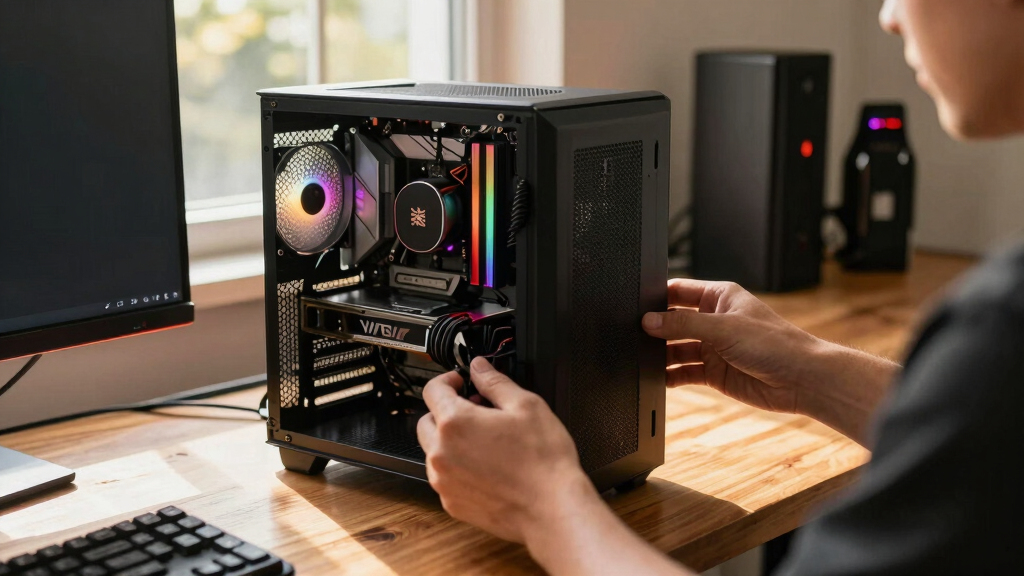
How We Picked
I ranked these cases for Steam gaming rather than general desk PC use, so GPU clearance, cooling path, riser generation, living-room placement, and build difficulty carried more weight than pure volume. The Fractal Design Ridge leads because it best matches a Steam Big Picture or TV setup while still supporting a serious ITX gaming build. The HYTE Revolt 3 sits close behind because it trades some living-room polish for practical portability and a less exotic layout. The JONSBO/JONSPLUS Z20 earns a high value slot because Micro-ATX and ATX PSU support can save money across the whole build, even though it is the least tiny of the stronger picks.
I placed the style-first and ultra-compact options lower when they ask buyers to accept tighter thermals, harder cable routing, older riser support, or less predictable documentation. The Fractal Design Terra is still a premium pick because it brings rare material quality and an adjustable internal layout, but it needs more careful part matching than Ridge or Revolt 3. The Lian Li VECTOR V100 favors visibility and included fans over the smallest footprint, while the JOYJOM and generic handle case are better for budget or experimental builds than for a high-confidence main Steam PC.
Factors to Consider When Choosing Best Small Form Factor PC Cases For Steam Gaming
The right small case depends less on the label and more on the kind of Steam gaming PC you are building. I would start with where the system will live, how hot the hardware will run, and how often you expect to move or upgrade it.
Choose The Room Before The Case
A Steam gaming case for a desk does not need to solve the same problem as one sitting under a TV. A console-style layout like the Ridge makes more sense for couch play because it can blend into an entertainment setup, while a tower like the Revolt 3 is easier to grab and carry. If the PC will stay beside a monitor, a slightly larger case may be worth it for cleaner airflow and simpler cable access. If it will move between rooms, handle strength, panel fit, and weight balance matter more than shaving off one or two liters. Buyers often chase the smallest shell first, then discover that the power cable, HDMI cable, and controller dongles make placement messy. I would pick the case around the actual room layout before getting pulled toward the smallest number on a spec sheet.
Match The GPU To The Cooling Budget
For Steam gaming, the GPU usually sets the tone for the whole case choice. A compact case can support a powerful graphics card on paper, but GPU thickness, fan intake space, and side-panel clearance decide whether it stays quiet during long play sessions. Cases like the Terra reward careful part matching, while roomier options such as the Z20 give builders more cooling margin. A case with a glass-heavy design can look better on a desk, but mesh access and fan paths tend to matter more once the system is rendering a demanding game. CPU cooler limits also matter because small cases often make you choose between more GPU room and more CPU cooling height. I would rather give up a little compactness than trap expensive gaming parts in a layout that runs hot and loud.
Price The Whole Build, Not Just The Case
The cheapest case is not always the cheapest Steam gaming PC. True Mini-ITX builds often push buyers toward Mini-ITX motherboards, SFX power supplies, riser cables, shorter coolers, and more selective GPU shopping. That is why the JONSBO/JONSPLUS Z20 can be a stronger value than smaller ITX-only cases: Micro-ATX and ATX PSU support may save real money across the build. Premium shells like the Terra can still be worth paying for, but the case price is only part of the spend. Budget handle cases look tempting when the upfront number is low, yet unclear clearances or weak documentation can create extra returns and replacement parts. I would compare the total parts list before deciding that a tiny case is the better deal.
Treat Riser Generation As Part Of The Budget
Many compact gaming cases use a riser cable to place the GPU away from the motherboard slot. A PCIe 4.0 riser is usually the cleaner fit for a modern Steam gaming build because it reduces setup friction with recent GPUs and motherboards. A PCIe 3.0 riser is not automatically a dealbreaker, but it can add BIOS tweaking, troubleshooting, or upgrade limits that a first-time SFF builder may not want. This is one reason the Ridge sits above the JOYJOM in my ranking despite both targeting compact ITX gaming. If you are building with expensive current-generation graphics hardware, riser quality should be treated like a core component rather than a throw-in cable. Saving money here can make sense for modest GPUs, but it is a poor place to gamble on a premium Steam machine.
Plan For Cleaning And Upgrades
Small PCs are easier to place, but they are not always easier to live with. Dust filters, removable panels, cable channels, and access to storage mounts all affect how annoying the system feels six months later. A case that is beautiful when finished can become frustrating if a simple SSD swap means pulling the GPU, riser, and power supply. For Steam gaming, upgrade access matters because game storage fills quickly and GPU demands keep rising. Portable cases also need extra attention to cable strain and panel security, since repeated movement can expose weak build choices. I would favor a case that lets me clean fans and reach key parts without rebuilding the entire PC.
Frequently Asked Questions
Is A Mini-ITX Case Better Than A Micro-ATX Case For Steam Gaming?
A Mini-ITX case is better when the goal is a console-like Steam PC, a compact desk setup, or a system that can move easily. A Micro-ATX case like the JONSBO/JONSPLUS Z20 is often better when value, cooler choice, and easier building matter more than the smallest footprint. ITX builds usually cost more because the motherboard, power supply, and cooler options are narrower. Micro-ATX gives up some compactness but can make the whole system cheaper and less fussy. I would choose Mini-ITX for a living-room or travel build, and Micro-ATX for a budget-conscious gaming PC that still feels compact.
Should I Pick The Fractal Design Ridge Or The HYTE Revolt 3?
The Fractal Design Ridge is the better fit if the PC will live near a TV, under a monitor, or in a room where console-like placement matters. Its slim shape and PCIe 4.0-ready layout make it feel more purpose-built for Steam couch gaming. The HYTE Revolt 3 makes more sense if you want a movable PC with a built-in handle and a more straightforward vertical tower feel. It is less subtle visually, but it has a clear advantage for LAN nights, dorm rooms, or shared spaces. I would choose Ridge for the living room and Revolt 3 for portability.
Is The Fractal Design Terra Too Small For A Powerful Steam Gaming PC?
The Fractal Design Terra can work for a powerful Steam gaming PC, but it rewards careful planning more than the Ridge, Revolt 3, or Z20. Its adjustable internal layout gives builders flexibility, yet that flexibility also means every GPU, CPU cooler, and cable choice matters. It is a great case for buyers who care about materials and footprint, not for someone who wants the easiest high-wattage build. Heat and noise can become more noticeable if the part list pushes the case too hard. I would pick Terra for a polished premium build with carefully chosen parts, not for a maximum-power, low-effort gaming tower.
Does A PCIe 3.0 Riser Make A Budget ITX Case A Bad Buy?
A PCIe 3.0 riser does not automatically make a case a bad buy, especially for a modest Steam gaming build using a midrange GPU. The problem is that it adds uncertainty when paired with newer motherboards and graphics cards that expect PCIe 4.0 behavior. Some builders may need BIOS changes or troubleshooting before the system behaves properly. That is acceptable for a budget project, but less appealing for an expensive main gaming PC. I would treat JOYJOM-style PCIe 3.0 riser cases as value or experiment picks, while choosing PCIe 4.0 for a cleaner premium build.
Are Handle Cases Actually Useful Or Just A Gimmick?
A built-in handle is useful if the PC really moves between rooms, desks, dorms, or LAN sessions. The HYTE Revolt 3 makes the strongest case for this design because portability is part of the whole structure, not just an add-on. Cheaper removable-handle cases can still be practical, but I would be more cautious about panel rigidity, weight balance, and how the handle attaches. A handle does not solve cable management, GPU support, or cooling by itself. I would buy a handle case only when movement is part of the plan, not just because it looks convenient.
Conclusion
My Best Overall pick is the Fractal Design Ridge because it fits the way many Steam gamers actually play: under a TV, beside a monitor, or in a compact entertainment setup with a real GPU inside. For Best Value, I would choose the JONSBO/JONSPLUS Z20 because Micro-ATX and ATX PSU support can lower the full build price more than a tiny case discount ever will. The Fractal Design Terra is my premium pick for buyers who want a case that looks like furniture, while the HYTE Revolt 3 is the beginner-friendly portable choice because it avoids some riser complexity and has a clear travel role. The Lian Li VECTOR V100 makes sense for RGB display builds, the JOYJOM is only for budget ITX builders who accept PCIe 3.0 riser limits, and the Mini ITX PC Case with Removable Handle is the fallback for a cheap movable build rather than my first choice for a main Steam gaming rig.
Fall Picks
fall essentials
As an affiliate, we earn on qualifying purchases.