
TL;DR
A November 3 report describes adapting the Ultra Low Complexity Codec (ULC) for Nintendo 64 audio. Its author says it plays 44.1 kHz stereo at bitrates near Opus while using about 4% of the N64’s CPU time, though implementation details and independent performance testing are not provided in the source.
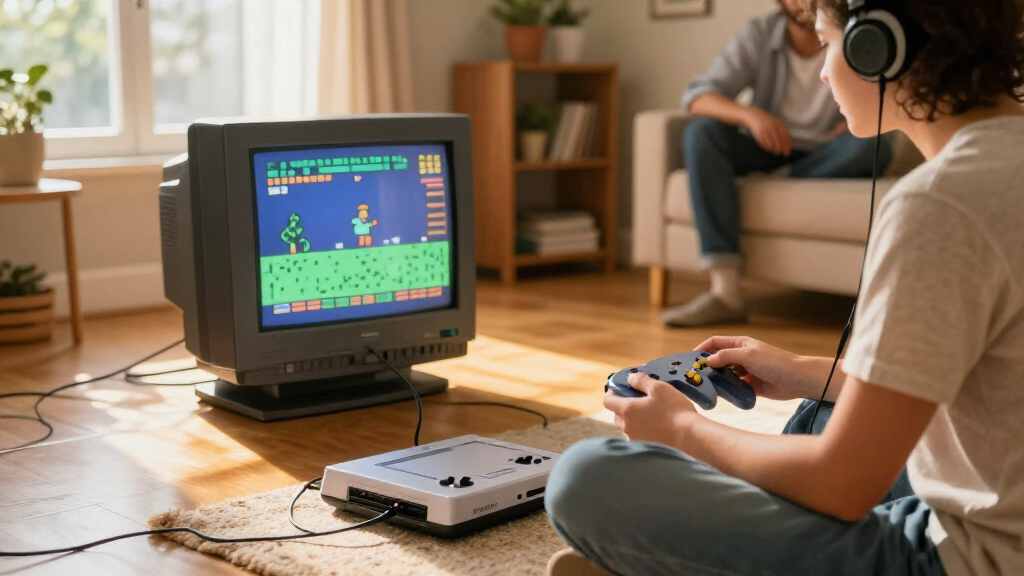
A developer has reported that the Ultra Low Complexity Codec (ULC) can play 44.1 kHz stereo audio on the Nintendo 64 at bitrates near Opus while using about 4% of the console’s CPU time. The November 3 report presents the codec as a way to store and play longer music tracks on cartridge-based N64 games without the space demands of less-compressed audio.

Play games on Amazon Luna for your game nights, included with Prime
- A rotating selection of games, no download needed
- Play on TV, laptop or phone
- Fast, free delivery for your gear, too
The report’s author says the test achieved 44100 Hz stereo at “near-Opus bitrates,” with the decoder taking about 4% of the N64’s CPU time. Those figures are the author’s reported results; the source does not provide a detailed benchmark methodology or independent verification. The report also does not specify the exact bitrate used for the N64 test.
ULC was created by developer Aikku93 for a Game Boy Advance audio demo, according to the report. It describes ULC as a transform codec, like MP3, that uses a modified discrete cosine transform to convert audio into frequency-domain coefficients. Rather than rely on MP3-style Huffman encoding, ULC stores coefficients in a simple, nibble-based format. The author says this avoids arbitrary bit reads and complex entropy decoding, making the decoder relatively straightforward to implement.
The codec also uses zero runs and noise fill to represent some audio data compactly. Noise fill can help with sounds such as cymbals and snare drums, the report says. ULC can produce usable results at 16 kbps, according to the author, although sound quality falls at that rate. The report says the codec’s code is permissively licensed, but it does not identify a specific license in the supplied material.
More Music in N64 Cartridges
The reported results could ease a longstanding trade-off for N64 developers: audio quality and length compete with limited cartridge storage and the console’s available processing time. Compressed playback could let games include longer recorded music or speech without devoting most of a cartridge to audio, while leaving more CPU capacity for gameplay than heavier formats require.
The report gives a practical example from Xibalba 64, whose developer says about 31 MB of its 32 MB ROM are used for sound and music stored as ADPCM. The game has about 15 minutes of music. That example illustrates why more efficient compression may be useful, but it is not a measured comparison of ULC against ADPCM in the same game. Whether ULC can replace existing audio pipelines will depend on sound quality, decoder integration, and results across different game content.
Popular right now

KitchenAid 5.5-Quart Bowl-Lift Stand Mixer, Porcelain White

iRobot Roomba 105 Robot Vacuum with LiDAR Navigation

De'Longhi La Specialista Touch Semi-Automatic Espresso Machine with Grinder
As an affiliate, we earn on qualifying purchases.
N64 Audio’s Storage Limits
The Nintendo 64 used cartridges rather than the CD format available to the PlayStation. According to the report, Nintendo’s Libultra library offered ADPCM playback accelerated by the console’s Reality Signal Processor (RSP), but third-party developers were generally not allowed to write directly for that processor. ADPCM reduces audio data compared with uncompressed PCM, yet the report estimates that five minutes of 44.1 kHz stereo still takes about 12 MB.
The report contrasts that requirement with the 8 MB size of Super Mario 64 and the 64 MB capacity of the largest N64 games. As a result, many games generated music during play by scheduling short samples rather than storing complete recordings. Some later developers gained direct RSP access: Conker’s Bad Fur Day used MP3 decoding for speech, but the report says its processing cost made continuous music or gameplay audio impractical.
The open-source Libdragon development environment now includes RSP-accelerated ADPCM and Opus decoders, according to the report. Its author says Opus compression and quality are strong, but decoding it remains too slow for gameplay use. ULC is presented as another option, designed around simpler coefficient handling rather than adapting a more demanding modern codec.
““44100 Hz stereo with near-Opus bitrates using about 4% of the N64’s CPU time.””
— The report’s author
Performance Claims Need Testing
The report does not publish the N64 test’s exact bitrate, measurement setup, or audio-quality results, and no independent test is included in the supplied source. “Near-Opus bitrates” is not defined with a number, so readers cannot directly compare the reported result with a particular Opus setting. It is also unclear how the decoder performs across different music, effects, and game workloads, or how much memory and development work integration would require.
The author’s comparisons with ADPCM and Opus describe the report’s assessment, not a controlled, side-by-side evaluation. The material also does not establish whether ULC has been adopted by other N64 projects or whether a complete, readily usable N64 implementation has been released alongside the report.
More Tests Could Establish Fit
The next useful step would be publication of the decoder implementation and benchmark details, including the tested bitrate, CPU measurement method, and listening comparisons. Tests using varied music and sound effects could show whether the codec’s reported efficiency holds beyond the material used in the initial demonstration.
Developers could then compare ULC with ADPCM and Opus in an actual N64 game build, measuring ROM use, playback quality, and CPU cost under gameplay conditions. The November 3 report does not announce a release schedule or adoption by a game project, so broader use remains unconfirmed.
Key Questions
What is ULC?
ULC stands for Ultra Low Complexity Codec. The report describes it as a transform audio codec developed by Aikku93, using a modified discrete cosine transform and a simple nibble-based format for storing coefficients.
What did the N64 test reportedly achieve?
The report’s author says ULC played 44.1 kHz stereo at bitrates near Opus while using about 4% of the N64’s CPU time. The supplied source does not give the exact bitrate or detailed benchmark method.
Why could this matter for N64 games?
More efficient audio compression could reduce the cartridge space needed for recorded music and speech, while keeping decoder demands low enough for game audio. The report’s results have not been independently verified in the supplied material.
Does ULC sound as good as Opus?
The report describes its tested bitrate as “near-Opus,” but does not provide a precise bitrate comparison or formal listening results. It says ULC quality declines at 16 kbps, despite remaining usable for some applications.
Is ULC already being used in N64 games?
The source does not confirm wider adoption. It discusses a reported N64 performance result and cites Xibalba 64 as an example of a game using ADPCM, not ULC.
Source: phoboslab.org