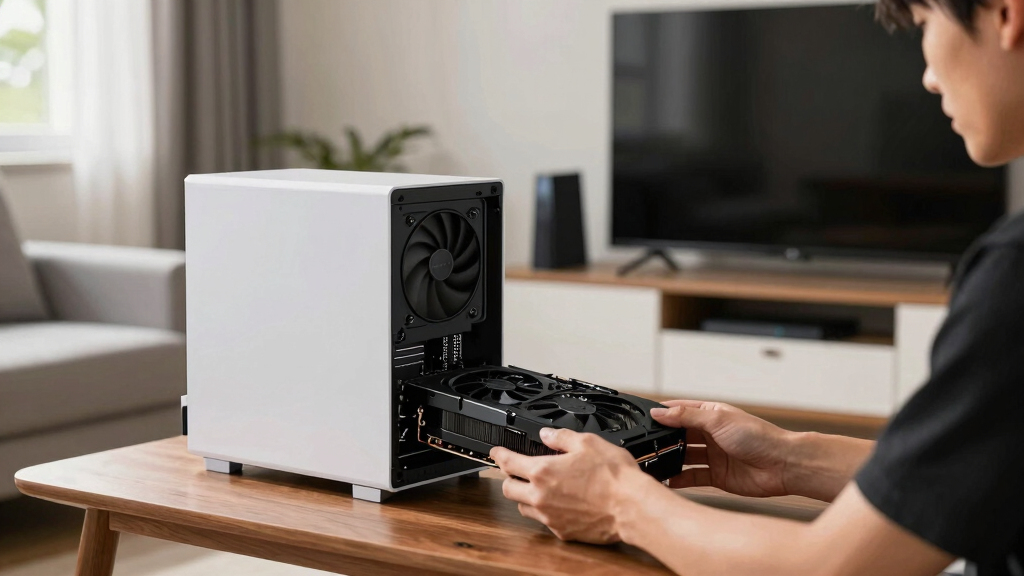

The ASUS Dual Radeon RX 9060 XT 16GB is my best overall pick for the best quiet graphics cards for living room PCs because it balances 16GB of memory, a couch-gaming-friendly performance target, and 0dB Technology. If you want more premium headroom, the ASUS SFF-Ready Prime GeForce RTX 5070 makes sense for a compact high-end build, while the ASUS Dual GeForce RTX 3050 6GB OC is the easier low-heat choice for 1080p and media-first PCs. The main tradeoff is simple: lower-power cards are easier to hush, but faster cards need more case space, better airflow, and a living room cabinet that can breathe. I also weighed SFF fit, TV-ready outputs, fan-stop behavior, and whether the card’s cooler matches the performance level. Continue reading for the full breakdown of which quiet GPU fits each type of living room PC.
Play games included with Prime
Start a Prime free trial and play with Amazon Luna on your devices.
Start playingAs an affiliate, we earn on qualifying purchases.
Key Takeaways
- I rank the ASUS Dual Radeon RX 9060 XT 16GB first because it offers the best mix of 16GB memory, fan-stop behavior, and manageable size.
- The RTX 5070 cards are better for premium couch gaming, but they need stronger case airflow than the RX 9060 XT picks.
- The RTX 3050 6GB models make the most sense for quiet 1080p, streaming, and media-first living room PCs.
- Physical fit separates the lineup: SFF-ready and 2-slot cards are often easier to keep quiet than thicker high-power options.
- The RX 9070 XT Gaming OC ICE has the strongest AMD performance profile here, but it is best saved for roomy cases and 4K TVs.
| ASUS Dual Radeon RX 9060 XT 16GB GDDR6 Graphics Card |  | Best Overall Quiet Living Room Pick | GPU: AMD Radeon RX 9060 XT | Memory: 16GB GDDR6 | Interface: PCIe 5.0 | VIEW LATEST PRICE | See Our Full Breakdown |
| GIGABYTE Radeon RX 9060 XT Gaming OC ICE 16G Graphics Card |  | Best Cooling-Focused Value Pick | GPU: AMD Radeon RX 9060 XT | Memory: 16GB GDDR6 | Memory Bus: 128-bit | VIEW LATEST PRICE | See Our Full Breakdown |
| ASUS SFF-Ready Prime NVIDIA GeForce RTX 5070 Graphics Card |  | Best Premium Compact Pick | GPU: NVIDIA GeForce RTX 5070 | Architecture: NVIDIA Blackwell | Memory: 12GB GDDR7 | VIEW LATEST PRICE | See Our Full Breakdown |
| ASUS Dual NVIDIA GeForce RTX 3050 6GB GDDR6 OC Edition Gaming Graphics Card |  | Best Quiet Budget NVIDIA Pick | GPU: NVIDIA GeForce RTX 3050 | Architecture: NVIDIA Ampere | Memory: 6GB GDDR6 | VIEW LATEST PRICE | See Our Full Breakdown |
| MSI Gaming RTX 3050 Ventus 2X 6G OC Graphics Card |  | Best Dual-HDMI Media Pick | GPU: NVIDIA GeForce RTX 3050 | Architecture: NVIDIA Ampere | Memory: 6GB GDDR6 | VIEW LATEST PRICE | See Our Full Breakdown |
| ASUS Prime GeForce RTX 5060 OC 8GB |  | Best Quiet Midrange NVIDIA Pick | GPU: NVIDIA GeForce RTX 5060 | Memory: 8GB GDDR7 | Architecture: NVIDIA Blackwell | VIEW LATEST PRICE | See Our Full Breakdown |
| PNY GeForce RTX 5070 Epic-X ARGB OC Triple Fan 12GB |  | Best Performance-Oriented NVIDIA Pick | GPU: NVIDIA GeForce RTX 5070 | Memory: 12GB GDDR7 | Memory Bus: 192-bit | VIEW LATEST PRICE | See Our Full Breakdown |
| GIGABYTE GeForce RTX 5070 WINDFORCE OC SFF 12GB |  | Best Balanced RTX 5070 for Small Cases | GPU: NVIDIA GeForce RTX 5070 | Model Number: GV-N5070WF3OC-12GD | Memory: 12GB GDDR7 | VIEW LATEST PRICE | See Our Full Breakdown |
| GIGABYTE Radeon RX 9070 XT Gaming OC ICE 16G |  | Best Premium AMD Pick | GPU: AMD Radeon RX 9070 XT | Memory: 16GB GDDR6 | Memory Bus: 256-bit | VIEW LATEST PRICE | See Our Full Breakdown |
More Details on Our Top Picks
ASUS Dual Radeon RX 9060 XT 16GB GDDR6 Graphics Card
I rank the ASUS Dual Radeon RX 9060 XT 16GB highest here because it balances the pieces that matter most in a living room PC: 0dB light-load operation, a dual-fan cooler, 16GB of VRAM, and a Quiet BIOS. Compared with the GIGABYTE Radeon RX 9060 XT Gaming OC ICE, it gives up the larger triple-fan cooler, but its shorter dual-fan approach should be easier to fit into TV cabinets and compact desktop cases. Against the RTX 3050 cards, it has far more gaming headroom for 1440p play and texture-heavy titles. The tradeoff is that the 2.5-slot cooler still needs real case breathing room, and buyers wanting maximum frame rates may prefer an RTX 5070-class card.
Pros:- 0dB mode helps keep light gaming and media use quiet
- 16GB GDDR6 memory gives more headroom than the RTX 3050 options
- Dual BIOS lets buyers choose quiet behavior over peak performance
- 2.5-slot design is more compact than many triple-fan gaming cards
Cons:- Still too thick for many low-profile or console-style cases
- Dual-fan cooling may run warmer than larger triple-fan cards under heavy load
- Lacks NVIDIA DLSS and CUDA ecosystem support
Best for: I would point this to living room PC builders who want quiet 1080p or 1440p gaming without moving up to a hotter premium GPU.
Not ideal for: I would skip it for very slim cases or buyers who want NVIDIA-specific features like DLSS 4.
- GPU:AMD Radeon RX 9060 XT
- Memory:16GB GDDR6
- Interface:PCIe 5.0
- Display Outputs:HDMI 2.1b, DisplayPort 2.1a
- Slot Width:2.5-slot
- Cooling:Axial-tech dual-fan design
- Quiet Feature:0dB technology
- BIOS:Dual BIOS with Quiet and Performance profiles
Bottom line: I would choose this first for a quiet living room PC that still needs serious gaming capability.
GIGABYTE Radeon RX 9060 XT Gaming OC ICE 16G Graphics Card
The GIGABYTE Radeon RX 9060 XT Gaming OC ICE 16G is the value play I would pick when case space is less tight and cooling matters more than minimal size. Its triple-fan WINDFORCE cooler, Hawk fans, copper heat pipes, and thermal gel give it more thermal hardware than the ASUS Dual Radeon RX 9060 XT, which can mean lower fan effort in a roomy living room case. It also keeps the same 16GB memory advantage over both RTX 3050 cards. The catch is physical presence: at 11.06 inches long with RGB lighting and three fans, it feels more like a visible gaming card than a discreet media-center part. The default Performance BIOS also means quiet-minded buyers should switch to Silent mode right away.
Pros:- Triple-fan WINDFORCE cooler gives it strong thermal capacity
- Silent BIOS gives buyers a quieter profile for TV-room use
- 16GB GDDR6 memory suits modern games better than 6GB cards
- Reinforced backplate helps support the longer card
Cons:- Longer 11.06-inch body needs more case clearance
- RGB styling may not suit subtle living room builds
- Performance BIOS is the default, so quiet use requires setup
Best for: I would point this to buyers using a full-size living room case who want RX 9060 XT performance with extra cooling overhead.
Not ideal for: I would skip it for compact cabinets, minimalist builds, or anyone who wants the least visible GPU possible.
- GPU:AMD Radeon RX 9060 XT
- Memory:16GB GDDR6
- Memory Bus:128-bit
- GPU Clock:2780 MHz
- Memory Clock:20000 MHz
- Interface:PCIe 5.0 x16
- Cooling:WINDFORCE triple-fan system with Hawk fans
- Dimensions:11.06 x 4.65 inches
- Warranty:3-year manufacturer warranty
Bottom line: I would buy this over the ASUS Dual RX 9060 XT only when the case has room for a larger, cooler-running card.
ASUS SFF-Ready Prime NVIDIA GeForce RTX 5070 Graphics Card
The ASUS SFF-Ready Prime GeForce RTX 5070 earns the premium slot because it brings newer NVIDIA Blackwell features and DLSS 4 into a card aimed at smaller systems. Compared with the ASUS Dual Radeon RX 9060 XT, this is the stronger choice for buyers who care about ray tracing, AI-assisted upscaling, and NVIDIA software support. Compared with the ASUS Dual RTX 3050, it is in a different performance class for high-refresh 1440p and living room 4K upscaling. The quiet angle depends on the build: Axial-tech fans and a phase-change thermal pad help manage heat, but a higher-end GPU can still push more warmth into a TV cabinet. The 2.5-slot SFF-ready body is compact for the class, not tiny.
Pros:- Blackwell architecture and DLSS 4 suit premium gaming setups
- SFF-ready design is compact for an RTX 5070-class card
- Axial-tech fans and phase-change thermal pad support controlled temperatures
- 12GB GDDR7 memory gives faster modern graphics memory than older cards
Cons:- Higher-performance GPU can create more heat than RX 9060 XT or RTX 3050 options
- 2.5-slot thickness may still block tight mini-ITX layouts
- Likely overkill for streaming, emulation, and light couch gaming
Best for: I would point this to living room gamers who want premium NVIDIA features in a small-form-factor case with decent airflow.
Not ideal for: I would skip it for budget media PCs, silent-first builds in sealed cabinets, or cases that cannot handle a 2.5-slot card.
- GPU:NVIDIA GeForce RTX 5070
- Architecture:NVIDIA Blackwell
- Memory:12GB GDDR7
- Interface:PCIe 5.0
- Display Outputs:HDMI, DisplayPort 2.1
- Cooling:2.5-slot Axial-tech fan design
- Thermal Material:Phase-change thermal pad
- Warranty:3 years
Bottom line: I would choose this when a living room PC needs premium NVIDIA gaming features without moving to a huge card.
ASUS Dual NVIDIA GeForce RTX 3050 6GB GDDR6 OC Edition Gaming Graphics Card
The ASUS Dual GeForce RTX 3050 6GB OC Edition makes sense when the living room PC is more about quiet 1080p gaming, streaming, and older titles than maxed-out new releases. Compared with the MSI Gaming RTX 3050 Ventus 2X, ASUS gives buyers a compact 7.9-inch card, a clear 2-slot layout, and Axial-tech cooling, which makes it easier to plan around small cases. Compared with the RX 9060 XT cards, though, the 6GB VRAM limit is the real dividing line: this is calmer, cheaper, and easier to house, but far less future-facing for modern textures. I like it most as a low-noise NVIDIA entry point, not as a long-term 1440p gaming card.
Pros:- Compact 7.9-inch length is friendly to smaller living room cases
- 2-slot design is easier to fit than 2.5-slot and triple-fan cards
- NVIDIA DLSS and ray tracing support at a lower price class
- Modern HDMI 2.1 output works well for TV connections
Cons:- 6GB VRAM can limit newer games and high-resolution texture packs
- Much slower than the RX 9060 XT and RTX 5070 options
- DisplayPort 1.4a is older than the ports on newer PCIe 5.0 cards
Best for: I would point this to couch gamers building a compact 1080p PC for esports, older games, streaming, and quiet everyday use.
Not ideal for: I would skip it for buyers who expect high settings in new AAA games or need 1440p longevity.
- GPU:NVIDIA GeForce RTX 3050
- Architecture:NVIDIA Ampere
- Memory:6GB GDDR6
- GPU Clock Speed:4000 MHz
- Memory Clock Speed:4000 MHz
- Display Outputs:HDMI 2.1, DisplayPort 1.4a
- Maximum Resolution:3840 x 2160
- Size:7.9 x 4.7 inches, 2-slot
- Warranty:3 years
Bottom line: I would buy this for a quiet, affordable NVIDIA living room PC focused on 1080p play.
MSI Gaming RTX 3050 Ventus 2X 6G OC Graphics Card
The MSI Gaming RTX 3050 Ventus 2X 6G OC is the RTX 3050 I would choose for a TV-centered setup that needs simple display hookup more than maximum gaming speed. Its two HDMI 2.1a ports are more convenient for many living room arrangements than the ASUS Dual RTX 3050’s single HDMI-plus-DisplayPort mix, especially if the PC may swap between a TV and another HDMI display. Performance expectations should stay modest: like the ASUS RTX 3050, it has 6GB of VRAM and a 96-bit interface, so the RX 9060 XT cards are better for newer games. The Ventus 2X cooler gives it a practical dual-fan layout, but it lacks the stronger quiet-specific claims found on the ASUS Dual RX 9060 XT.
Pros:- Two HDMI 2.1a outputs are useful for living room display setups
- Dual-fan Ventus 2X cooler is practical for mainstream cases
- DLSS support helps stretch entry-level gaming performance
- Lower performance class can be easier to cool than premium GPUs
Cons:- 6GB VRAM and 96-bit bus limit modern gaming headroom
- Only one DisplayPort output reduces monitor flexibility
- No listed 0dB mode or dual quiet BIOS
Best for: I would point this to media-center builders who want a modest NVIDIA card with extra HDMI flexibility for TVs and receivers.
Not ideal for: I would skip it for buyers chasing quiet high-settings gaming, 1440p headroom, or newer NVIDIA Blackwell features.
- GPU:NVIDIA GeForce RTX 3050
- Architecture:NVIDIA Ampere
- Memory:6GB GDDR6
- Memory Interface:96-bit
- Boost Clock:1492 MHz
- Memory Speed:14 Gbps
- Display Outputs:2 x HDMI 2.1a, 1 x DisplayPort 1.4a
- Cooling:MSI Ventus 2X dual-fan design
Bottom line: I would choose this when HDMI flexibility matters more than raw gaming performance.
ASUS Prime GeForce RTX 5060 OC 8GB
I rank the ASUS Prime GeForce RTX 5060 OC as the quieter-minded NVIDIA choice for buyers who care more about a calm living room PC than chasing the highest frame rates. Compared with the PNY GeForce RTX 5070 Epic-X ARGB, it gives up memory capacity and raw GPU headroom, but the smaller RTX 5060 class should be easier to cool inside a TV cabinet or compact case. The SFF-ready 2.5-slot design, axial-tech fans, and Dual BIOS make it a practical fit for users who want DLSS 4 without building around a larger, hotter card. The tradeoff is clear: 8GB of VRAM is less future-friendly than the 12GB and 16GB cards in this batch, so this is better for quiet 1080p or lighter 1440p gaming than heavy ultra-texture play.
Pros:- SFF-ready 2.5-slot design suits compact living room cases
- Dual BIOS gives buyers a way to favor quieter behavior
- DLSS 4 support helps stretch performance without raising noise as much
- Axial-tech fan design focuses airflow through the heatsink
Cons:- 8GB of VRAM is limiting beside 12GB and 16GB rivals
- Less performance headroom than the RTX 5070 and RX 9070 XT picks
- Still occupies 2.5 slots, so it is not a true ultra-slim card
Best for: Living room PC builders who want current NVIDIA features, modest heat output, and a compact card for 1080p or lighter 1440p gaming.
Not ideal for: Buyers who want high-resolution texture packs or long-term 1440p headroom, since the 8GB VRAM pool is tighter than the RTX 5070 and RX 9070 XT options.
- GPU:NVIDIA GeForce RTX 5060
- Memory:8GB GDDR7
- Architecture:NVIDIA Blackwell
- PCIe:PCIe 5.0
- OC Clock:2595 MHz OC mode
- Default Clock:2565 MHz default mode
- Cooling:Axial-tech fans
- Slot Width:2.5-slot
- BIOS:Dual BIOS
Bottom line: This is the RTX pick I would shortlist for a quiet compact build where efficiency matters more than max settings.
PNY GeForce RTX 5070 Epic-X ARGB OC Triple Fan 12GB
The PNY GeForce RTX 5070 Epic-X ARGB OC is the card I would place above the ASUS RTX 5060 for buyers who want stronger 1440p gaming from a living room machine. Its 12GB GDDR7 memory, 192-bit bus, and higher 2685 MHz boost clock give it more room for modern games than the ASUS RTX 5060, while staying more compact than many full-size performance cards thanks to its SFF-ready 2.4-slot build. The triple-fan cooler should help spread heat at lower fan speeds, but this is also the reason it needs more case planning than simpler dual-fan cards. Compared with the GIGABYTE RTX 5070 WINDFORCE OC SFF, PNY adds ARGB styling, which can suit a visible media PC but may feel unnecessary in a discreet living room setup.
Pros:- 12GB GDDR7 memory is better suited to 1440p games than 8GB cards
- Triple-fan cooler can spread thermal load across more surface area
- SFF-ready 2.4-slot format is compact for this performance class
- DLSS 4 and Reflex support fit both cinematic and responsive gaming
Cons:- Triple-fan length may be awkward in short living room cases
- ARGB lighting adds visual flash that some TV setups will not want
- Likely draws more power and produces more heat than RTX 5060 options
Best for: Living room gamers who want a stronger NVIDIA card for 1440p play and have a case that can handle a triple-fan 2.4-slot GPU.
Not ideal for: Minimalist media-center builds where lighting, size, and heat are bigger concerns than higher frame rates.
- GPU:NVIDIA GeForce RTX 5070
- Memory:12GB GDDR7
- Memory Bus:192-bit
- Architecture:NVIDIA Blackwell
- Boost Clock:2685 MHz
- PCIe:PCIe 5.0
- Cooling:Triple fan
- Slot Width:2.4-slot
- Display Outputs:HDMI and DisplayPort 2.1
Bottom line: Choose this when the living room PC is also a serious 1440p gaming system and the case has room to breathe.
GIGABYTE GeForce RTX 5070 WINDFORCE OC SFF 12GB
The GIGABYTE GeForce RTX 5070 WINDFORCE OC SFF earns its spot by aiming for the middle ground: more gaming headroom than the ASUS RTX 5060, but less showy than the PNY RTX 5070 Epic-X ARGB. For a living room PC, that balance matters. The WINDFORCE cooling system and compact SFF design make it feel better matched to a media cabinet build than bulkier performance cards, while the 12GB GDDR7 on a 192-bit interface gives it stronger 1440p footing than 8GB options. Its main drawback is value pressure: buyers paying RTX 5070 money may expect premium acoustic controls, yet the listing does not call out Dual BIOS like the ASUS Prime RTX 5060 or GIGABYTE RX 9070 XT ICE. It also may ask more from the power supply than lower-tier cards.
Pros:- RTX 5070 performance class gives better 1440p headroom than RTX 5060 cards
- Compact SFF design fits the living room PC brief well
- WINDFORCE cooler is built for controlled thermals in smaller builds
- 12GB 192-bit GDDR7 memory is stronger for modern games than 8GB options
Cons:- Higher price point than midrange quiet-PC choices
- May require a power supply upgrade in older living room systems
- No listed Dual BIOS, which weakens its quiet-tuning story
Best for: Small-form-factor builders who want RTX 5070-class 1440p performance without leaning into visible RGB lighting.
Not ideal for: Budget media PC owners using an older or lower-wattage power supply, since this card may require a broader system upgrade.
- GPU:NVIDIA GeForce RTX 5070
- Model Number:GV-N5070WF3OC-12GD
- Memory:12GB GDDR7
- Memory Bus:192-bit
- Architecture:NVIDIA Blackwell
- PCIe:PCIe 5.0
- Cooling:WINDFORCE cooling system
- Form Factor:SFF graphics card
- Key Feature:DLSS 4 support
Bottom line: This is the RTX 5070 I would pick for a compact, understated living room gaming PC.
GIGABYTE Radeon RX 9070 XT Gaming OC ICE 16G
The GIGABYTE Radeon RX 9070 XT Gaming OC ICE 16G is the big-horsepower choice in this group, and I would only rank it this way for living room PCs that can handle its size and heat. Compared with the GIGABYTE RTX 5070 WINDFORCE OC SFF, it offers a larger 16GB GDDR6 memory pool and a wider 256-bit bus, which helps with high-resolution textures and longer-term game demands. Its quiet credentials come from the WINDFORCE cooler, Hawk fans, server-grade thermal gel, and Dual BIOS with Silent mode. The catch is physical fit: at 2.7 slots, this is less friendly to cramped media cases than the RTX 5060 or RTX 5070 SFF cards. It also brings RGB lighting, which may clash with a low-key TV setup.
Pros:- 16GB VRAM and 256-bit bus give it the strongest memory headroom in this batch
- Dual BIOS includes a Silent mode for quieter operation
- WINDFORCE cooler uses Hawk fans, thermal gel, copper heat pipes, and screen cooling
- DisplayPort 2.1 support suits newer high-refresh displays
Cons:- 2.7-slot size is harder to fit in compact living room cases
- Likely higher heat and power demands than RTX 5060 and RTX 5070 SFF cards
- RGB lighting may not suit a subtle media-center build
Best for: AMD-focused living room gamers with a roomy case who want 16GB of VRAM and a Silent BIOS option for quieter couch gaming.
Not ideal for: Tiny SFF builds or discreet home-theater PCs where a 2.7-slot card, higher heat, and RGB lighting would be a poor match.
- GPU:AMD Radeon RX 9070 XT
- Memory:16GB GDDR6
- Memory Bus:256-bit
- PCIe:PCIe 5.0
- Display Outputs:HDMI and DisplayPort 2.1
- Slot Width:2.7-slot
- Cooling:WINDFORCE with Hawk fans
- Thermal Material:Server-grade thermal conductive gel
- BIOS:Dual BIOS, Performance and Silent modes
Bottom line: Pick this for a larger AMD living room rig where quiet tuning and memory headroom matter more than compactness.
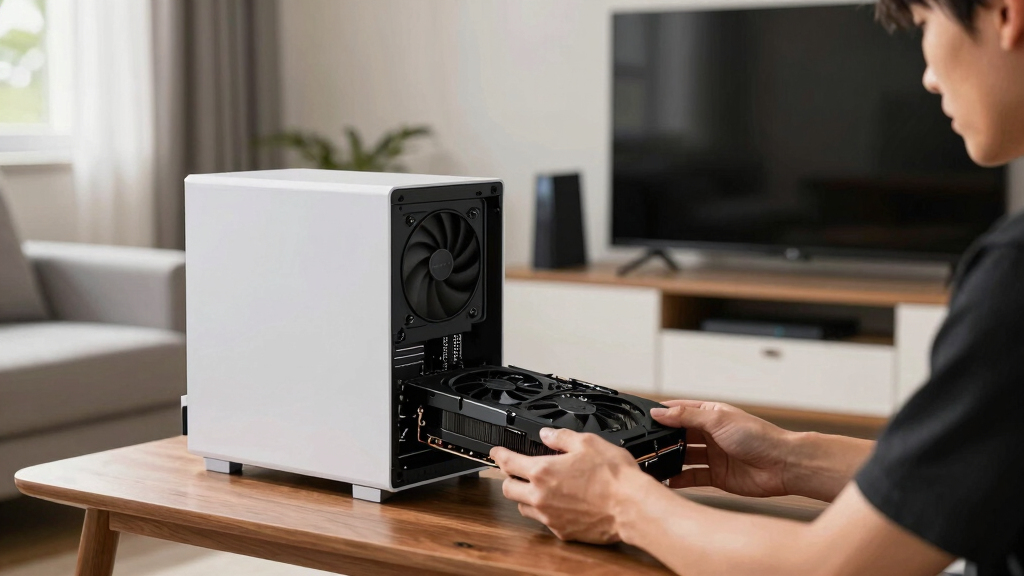
How We Picked
I ranked these nine cards through a living-room lens rather than a raw benchmark chart. The highest slots went to models with a believable quiet profile: moderate heat output, cooler size that matches the chip, fan-stop or quiet-BIOS features where listed, and enough performance to avoid loud sustained loads during couch gaming. I also gave weight to case fit, because a 2-slot or SFF-ready card can be easier to place in a TV stand PC than a thick board that needs more clearance. Outputs mattered too, especially HDMI 2.1-class support for TVs and DisplayPort 2.1 for monitor flexibility.
The order favors balanced quiet performance first, then value, then premium headroom. That is why the ASUS Dual Radeon RX 9060 XT 16GB sits above faster cards: it has the best mix of memory, 0dB idle behavior, and manageable size for this use case. The RTX 5070 and RX 9070 XT options rank higher only when their extra speed is matched by SFF-ready design, dual BIOS control, or a cooler that looks suited to the heat. Budget cards rank lower on speed, but they still earn a clear place because less heat often means less fan noise in a shared room.
Factors to Consider When Choosing Best Quiet Graphics Cards For Living Room PCs
A quiet living room GPU is not just the quietest spec sheet. I focus on the decisions that change daily use: heat, airflow, TV support, size, and where spending extra actually helps.
Start With Heat Before Fan Count
I treat heat output as the first noise predictor because every cooler has to move that heat somewhere. A low-power card like an RTX 3050 6GB can stay quiet in a modest case because it asks less from the fans, even if the cooler is simple. A faster card such as an RX 9070 XT can still be civilized, but it needs a larger heatsink, cleaner airflow, and more room behind the TV stand. Fan count alone can mislead buyers; two good fans on a midrange card may sound calmer than three small fans fighting a hot case. My rule is to match GPU class to the noise level you will accept during long couch sessions.
Check The Case And TV Stand Together
Living room PCs fail quietly when the card fits the case but the case cannot breathe inside the furniture. I look at slot width, card length, power connector clearance, and the empty space around the case after it slides into the cabinet. A 2.7-slot card may be quieter on an open desk, yet louder in a cramped console shelf because warm air circles back into the intake. SFF-ready cards such as the GIGABYTE GeForce RTX 5070 WINDFORCE OC SFF are attractive because they leave more room for case airflow. Before paying for a premium GPU, I would rather spend a little time mapping the full airflow path from intake to exhaust.
Prioritize The TV Experience, Not Only Frame Rates
A living room PC behaves differently from a tower tied to a monitor. I give extra credit to modern HDMI support, quiet idle behavior, fast wake, and enough video memory for high-resolution textures when the TV is 4K. The ASUS Dual Radeon RX 9060 XT 16GB scores well here because 16GB gives it more breathing room than 8GB cards when game settings rise. Nvidia cards in this list may appeal more if you lean on upscaling, frame generation, or app support that works better in your media setup. The best pick is the one that keeps menus, streaming apps, and games feeling smooth without turning the PC into the loudest object in the room.
Do Not Pay For Speed You Will Hide
Many living room builds run with frame caps, V-sync, or a quiet power profile, which changes the value math. If you are playing lighter games or older titles at 1080p, a GeForce RTX 3050 6GB can make more sense than a much faster card that spends most of its life throttled for noise. For 1440p couch gaming, I see the RX 9060 XT and RTX 5060 tier as the sweet spot because they have enough headroom without pushing into large-case territory. For 4K or high-refresh play, the RTX 5070 and RX 9070 XT options earn their higher price only if your case ventilation can support them. I would rather buy one tier lower and keep the PC pleasant than chase unused frames in a cabinet.
Quiet Controls Matter More Than Lighting
RGB and factory overclocks can be nice, but they do less for living room comfort than fan curves, dual BIOS modes, and idle fan-stop behavior. A card with a quiet BIOS lets you trade a little speed for lower acoustics without editing software every time the PC boots. This is why the ASUS SFF-Ready Prime RTX 5070 and ASUS SFF-Ready Prime RTX 5060 deserve attention beyond their raw specs. A showcase card like the PNY RTX 5070 Epic-X ARGB OC may suit a visible glass case, yet its lighting is less useful in a media cabinet than cooler capacity and fan tuning. My bias is clear: pay for control, fit, and thermals before paying for visual flair.
Frequently Asked Questions
Should I Buy An RTX 5070 Or An RX 9060 XT For A Quiet Living Room PC?
I would choose an RTX 5070 if the build needs higher 1440p or entry-level 4K gaming, stronger upscaling support, and an SFF-ready card that still fits the case. I would choose the ASUS Dual Radeon RX 9060 XT 16GB if quiet balance matters more than peak speed. Its 16GB memory and 0dB idle behavior make it a cleaner fit for many couch setups. The RTX 5070 tier asks more from the case and power supply, so it can be harder to keep silent in a closed cabinet. For most living room PCs, my vote starts with the RX 9060 XT unless the TV and game library call for extra graphics headroom.
Is A 6GB RTX 3050 Enough For A Living Room Gaming PC?
Yes, but only for the right kind of living room PC. I see the ASUS Dual RTX 3050 6GB OC and MSI RTX 3050 Ventus 2X 6G OC as low-heat choices for 1080p gaming, streaming, emulation, and quiet family-room use. They are easier to cool than the RTX 5070 or RX 9070 XT cards, which can make them quieter in small cases. The tradeoff is limited memory, lower frame rates, and less room for newer games with heavy textures. If your TV is 4K and you want current AAA games, I would move up to the RX 9060 XT or RTX 5060 tier.
Are Triple-Fan Cards Quieter Than Dual-Fan Cards?
Triple-fan cards can run slower at the same heat load, but they are not automatically quieter in a living room PC. The PNY RTX 5070 Epic-X ARGB OC Triple Fan has more cooling surface than many dual-fan cards, which can help under gaming loads if the case has space. A balanced dual-fan model like the ASUS Dual Radeon RX 9060 XT 16GB may still sound calmer because the GPU itself produces less heat. In a compact enclosure, a long triple-fan card can sit too close to panels or cables, raising turbulence. I would treat fan count as one clue, then check power draw class, slot width, and case airflow before picking.
Which Card Makes The Most Sense For A Small-Form-Factor Case Under A TV?
For a small-form-factor case, I would start with the GIGABYTE GeForce RTX 5070 WINDFORCE OC SFF if you want high-end Nvidia performance in a card shaped for tighter builds. If the system does not need that much speed, the GIGABYTE Radeon RX 9060 XT Gaming OC ICE 16G is appealing because its 2-slot design should be easier to house. The ASUS SFF-Ready Prime RTX 5060 8GB lands between them as a quieter-minded midrange Nvidia pick. The key is not only card length; slot width and power connector space can decide whether the side panel closes cleanly. My practical pick for most compact couch builds is the RX 9060 XT ICE unless you specifically want the Nvidia feature set.
When Is The RX 9070 XT Worth It For A Quiet Living Room PC?
The GIGABYTE Radeon RX 9070 XT Gaming OC ICE 16G is worth it when the living room PC has a roomy case, strong exhaust airflow, and a 4K TV that will use the extra GPU power. It gives you a wider 256-bit memory bus and 16GB of memory, so it targets a higher class than the RX 9060 XT. The downside is heat: a fast card can be quiet only when the case can feed it cool air. Compared with the ASUS SFF-Ready Prime RTX 5070, the RX 9070 XT is the bolder AMD performance pick, while the RTX 5070 may be easier to place in tighter SFF builds. I would skip the RX 9070 XT for a closed TV cabinet unless the enclosure was designed for gaming hardware.
Conclusion
My short version is this: choose the card that matches the room, not just the benchmark chart.
- Best overall: ASUS Dual Radeon RX 9060 XT 16GB, because it gives the best balance of quiet behavior, memory, and living room fit.
- Best value: MSI RTX 3050 Ventus 2X 6G OC, for 1080p and media-first builds that need low heat more than high frame rates.
- Best for beginners: ASUS Dual RTX 3050 6GB OC, for a simple low-noise Nvidia setup.
- Best premium pick: ASUS SFF-Ready Prime RTX 5070, for compact high-end couch gaming with quiet-mode flexibility.
- Best for compact high-end builds: GIGABYTE RTX 5070 WINDFORCE OC SFF, when space is tight but performance still matters.
- Best for larger 4K AMD builds: GIGABYTE RX 9070 XT Gaming OC ICE 16G, as long as the case has the airflow to keep it calm.
Fall yard work Picks
leaf blowers
As an affiliate, we earn on qualifying purchases.