
TL;DR

Get games and gaming gear delivered free — and shop member deals
- Fast, free delivery on millions of items
- Access to Prime Big Deal Days deals on October 6–7
- Prime Video, Amazon Music and more included
An open-source web application leverages computer vision and WebHID to automatically pilot a Steam Controller into its magnetic charging puck. This development enables hands-free charging and showcases innovative use of CV and web tech.
An open-source web application is now capable of automatically guiding a Steam Controller into its magnetic charging puck using computer vision and WebHID telemetry. This innovative system employs optical flow tracking and haptic feedback to enable autonomous docking, representing a significant step in controller automation and DIY hardware projects.
The project uses OpenCV.js to track user-selected points on the controller and the puck via an overhead webcam, enabling real-time optical flow analysis. It connects to the Steam Controller via WebHID to stream input data and control haptic pulses that guide the controller toward the puck. When the controller approaches within 150 pixels, the system reduces haptic pulse frequency to facilitate gentle magnetic docking.
Developers have integrated a proximity creep mode that automatically adjusts haptic feedback for smooth docking. The system also polls battery status through specific reports, confirming successful charging and displaying live battery metrics. Setup requires only a web browser supporting WebHID, a webcam mounted overhead, and the project can be started with a single command using the Nix package manager, making it accessible across Windows, Mac, and Linux platforms.
The project’s architecture involves a Vue 3 frontend, Rust/WebAssembly modules for high-performance visual processing, and custom WebHID abstractions to communicate with the controller. It is licensed under the MIT License and credits an anonymous researcher and the community for inspiration.
Potential Impact of Autonomous Controller Docking
This development demonstrates how computer vision and web technologies can be combined to create hands-free charging solutions for gaming hardware. It could inspire DIY enthusiasts and hardware modders to develop similar automation systems, reducing manual effort and wear on controllers. Additionally, it highlights the growing role of web-based control and CV applications in consumer device management, potentially influencing future hardware design and user interaction paradigms.
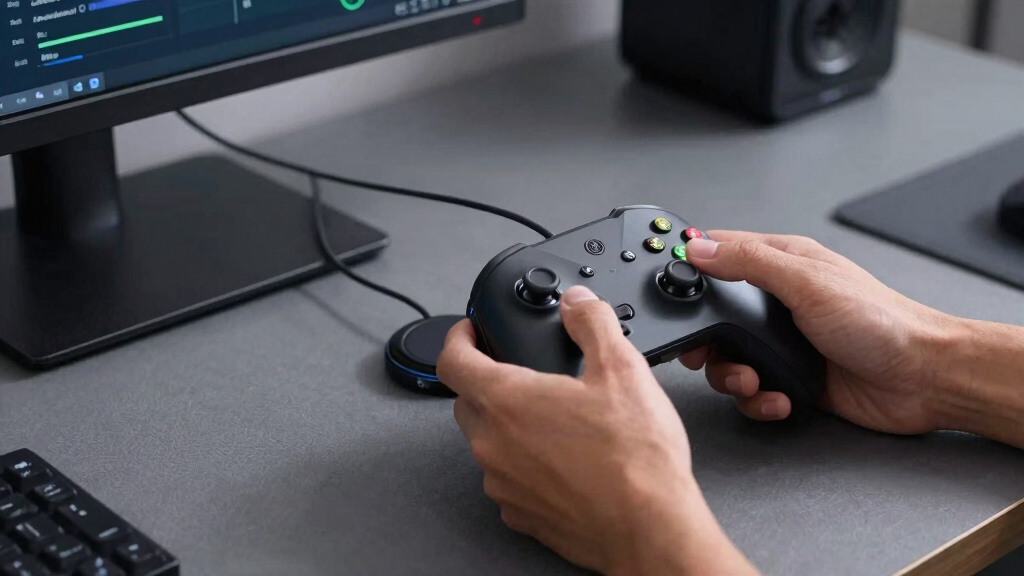
Steam Controller magnetic charging puck
As an affiliate, we earn on qualifying purchases.
As an affiliate, we earn on qualifying purchases.
Background of Controller Charging Automation
While traditional controller charging relies on manual placement on docks or charging stations, this project introduces an automated approach using optical flow tracking and haptic guidance. The concept builds on prior DIY and hacking communities’ interest in modifying and automating gaming peripherals. The use of WebHID for direct device communication and OpenCV.js for visual processing reflects a broader trend of leveraging web technologies for hardware control, especially in open-source projects. The project was inspired by community efforts to enhance gaming hardware usability and reduce manual intervention.
“This system shows how accessible web tech can be used to automate hardware interactions, opening new possibilities for DIY gaming setups.”
— an anonymous researcher
automatic controller docking system
As an affiliate, we earn on qualifying purchases.
As an affiliate, we earn on qualifying purchases.
Unanswered Questions About Reliability and Compatibility
It is not yet clear how reliably the system performs under different lighting conditions or with various controller models. The project is in an experimental phase, and real-world testing results are limited. Compatibility with future controller firmware updates or different hardware configurations remains unconfirmed. Additionally, the safety and long-term effects of haptic-guided docking have not been thoroughly evaluated.
webcam guided gaming controller charger
As an affiliate, we earn on qualifying purchases.
As an affiliate, we earn on qualifying purchases.
Next Steps for Development and Adoption
Further testing and refinement are expected to improve system reliability and robustness. Developers may work on automating calibration processes and expanding compatibility. Community feedback and contributions could lead to broader adoption, and potential integration into commercial products or custom gaming setups might be explored. Ongoing updates and documentation are likely as the project matures.
DIY Steam Controller charging station
As an affiliate, we earn on qualifying purchases.
As an affiliate, we earn on qualifying purchases.
Key Questions
How does the system guide the controller into the puck?
It uses optical flow tracking via an overhead webcam and haptic feedback to steer the controller automatically toward the magnetic puck.
What hardware is required to run this system?
A webcam mounted overhead, a Steam Controller, and a computer running a compatible browser supporting WebHID are needed. Setup involves minimal dependencies.
Is this system safe for the controller?
The project is experimental; while it aims for gentle docking, long-term safety and effects of haptic guidance are not yet fully evaluated. Users should proceed with caution.
Can this be used with other controllers or devices?
Currently, it is designed specifically for Steam Controllers using WebHID. Compatibility with other devices has not been tested or confirmed.
Source: Hacker News
Halloween Picks
halloween
As an affiliate, we earn on qualifying purchases.