
TL;DR

Get games and gaming gear delivered free — and shop member deals
- Fast, free delivery on millions of items
- Access to Prime Big Deal Days deals on October 6–7
- Prime Video, Amazon Music and more included
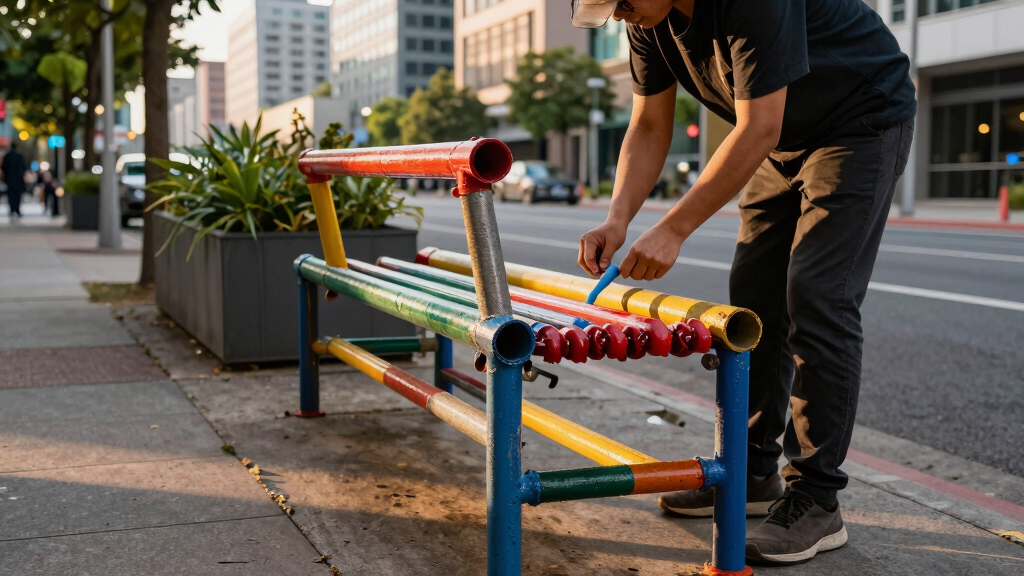
Scaffolding pipes and street furniture have been repurposed into a temporary public space at a future development site in Osaka. The project aims to test community use and urban activation before permanent construction. The initiative highlights innovative approaches to temporary urban design.
Scaffolding pipes and urban street furniture have been repurposed into a temporary public space at a vacant site along Osaka’s Midosuji boulevard. The initiative, called GAS STAND, aims to activate the site before the planned construction of a mixed-use building, including the Daigas Group headquarters. This project offers a glimpse into how temporary interventions can foster community engagement and urban vitality during pre-construction phases.
Developed by design studio team raw row for Osaka Gas Urban Development, GAS STAND transforms a currently undeveloped plot into a flexible, community-oriented environment. Using familiar urban components such as benches, bulletin boards, traffic mirrors, and scaffolding pipes, the site encourages informal gatherings, information sharing, and neighborhood activities. These elements are arranged in a way that visually and functionally extends the existing streetscape, blurring the boundary between public and private space.
The project emphasizes adaptability; the individual components are not fixed but can be rearranged to suit changing activities over time. This approach allows the site to evolve organically, reflecting the neighborhood’s daily rhythms and testing new forms of public use during the pre-construction period. The intervention serves as a prototype for future urban activation strategies, exploring how temporary design can influence community life and spatial identity before permanent development occurs.
Innovative Approach to Pre-Development Urban Activation
This temporary activation demonstrates how urban spaces can be dynamically used before permanent construction, fostering community engagement and testing new spatial configurations. It offers a model for other cities seeking to maintain vibrancy and public participation during development phases, potentially influencing future urban planning practices.
adjustable street furniture benches
As an affiliate, we earn on qualifying purchases.
As an affiliate, we earn on qualifying purchases.
Temporary Use as a Precursor to Urban Development
The site is located along Midosuji, Osaka’s main north–south boulevard, an area characterized by high pedestrian activity during weekdays but quieter weekends. The planned development includes a mixed-use building with office and commercial spaces, but construction has not yet begun. Prior to this project, the site remained vacant, with limited public interaction or street-level activity. GAS STAND introduces a temporary, adaptable environment that responds to the neighborhood’s character and tests how public life can be fostered during the interim period.
“The project reimagines familiar urban elements as tools for community engagement, creating a flexible environment that evolves with the neighborhood.”
— an anonymous researcher
portable scaffolding pipes for urban projects
As an affiliate, we earn on qualifying purchases.
As an affiliate, we earn on qualifying purchases.
Unclear Long-Term Impact of Temporary Activation
It is not yet clear how long the temporary installation will remain or how it will influence the final development design. The extent to which community use will be sustained or scaled in future phases remains uncertain, as the project is still in its early stages.
As an affiliate, we earn on qualifying purchases.
Next Steps for Urban Activation and Development
The site will continue to host community activities during the interim period, providing feedback for future planning. Once the planned mixed-use development begins, the temporary structures are expected to be dismantled or integrated into the final design. Further evaluation will determine how such temporary interventions can inform long-term urban strategies.
As an affiliate, we earn on qualifying purchases.
Key Questions
How long will the temporary street furniture remain in place?
The exact duration has not been specified, but it is intended as a temporary measure during the pre-construction phase.
Will the temporary installation influence the final development design?
It is possible that community feedback and the success of the activation will inform future planning, but specific influences are not yet confirmed.
Who developed the GAS STAND project?
The project was developed by design studio team raw row for Osaka Gas Urban Development.
What materials are used in the temporary street furniture?
Common urban components such as scaffolding pipes, traffic mirrors, bulletin boards, and planters are repurposed for the installation.
Is this approach unique to Osaka or part of a broader trend?
While temporary urban interventions are increasingly common, this project is a specific example of reusing construction materials for community activation during development phases.
Source: designboom
Halloween Picks
halloween
As an affiliate, we earn on qualifying purchases.