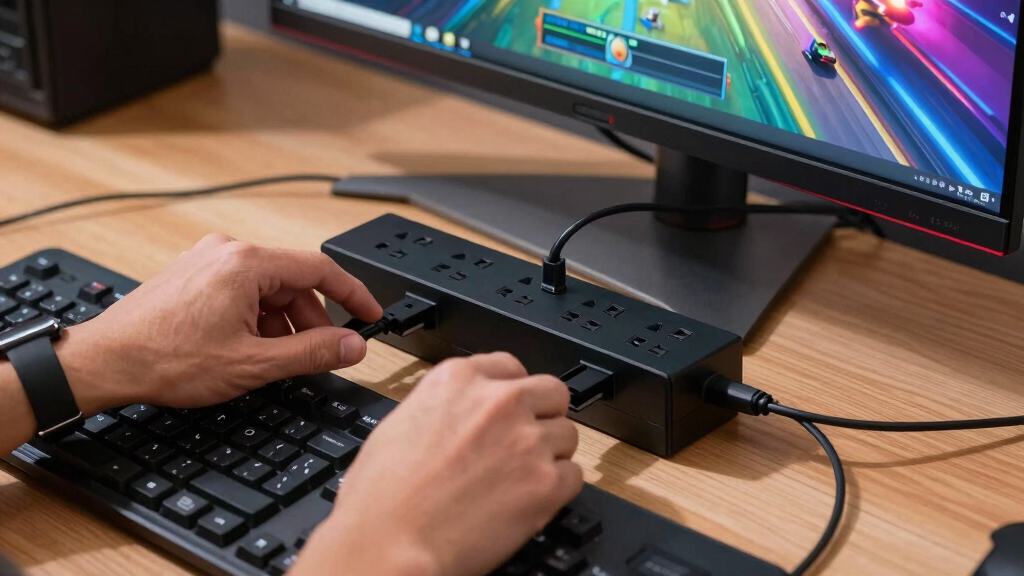

The best surge protector for most gaming setups is the Anker 12-Outlet Power Strip, which balances 2100-joule protection, mixed USB charging, and enough outlets for a PC or console station. The CyberPower CP1500PFCLCD is my premium pick because its battery backup, voltage regulation, and sine-wave output protect against outages as well as surges. Buyers seeking more protection per dollar should examine the 2700J 12-Outlet Power Strip, while the 4000J RGB model is the visual match for an illuminated desk. The main tradeoffs are protection depth, outlet spacing, desk footprint, charging features, and whether battery backup justifies the added cost. Continue reading for the full breakdown and buyer-specific recommendations.

Play games on Amazon Luna for your game nights, included with Prime
- A rotating selection of games, no download needed
- Play on TV, laptop or phone
- Fast, free delivery for your gear, too
Complete the kit


Key Takeaways
- Anker earns the best-overall position because its 12-outlet layout, 2100J rating, USB-C port, and manageable five-foot cord form the most balanced package.
- CyberPower is the only option here that keeps equipment running during a short outage, making it a better premium purchase for expensive PCs than a higher-joule strip alone.
- The 2700J 12-outlet model offers the strongest value case, pairing a higher published joule rating than Anker with ETL listing and four USB ports.
- More outlets do not automatically mean a better gaming strip; the 18- and 22-outlet models suit multi-monitor or streaming stations but consume more space and make load management harder.
- The 4000J RGB strip serves a distinct aesthetic role, while Belkin is the simpler beginner choice for buyers who favor a familiar, straightforward design over USB charging or lighting.


| surge protectors for gaming setup | Surge protection | AC outlets | USB ports | Cord length |
|---|---|---|---|---|
| 4000J Surge Protector Power St | 4000J | 6 | 1 USB-A and 2 USB-C | — |
| Addtam Black Power Strip Surge | 1050J | 12 | 4 | 5 ft |
| Power Strip with 12 Outlets an | 2700J | 12 | 4, including 1 USB-C | 6 ft |
| Power Strip with 22 Outlets an | 2100J | 22 grounded outlets | 6 (5 USB-A and 1 USB-C) | 6.5 ft |
| Anker Power Strip with 2100J S | 2100J | 12 | 3 (2 USB-A and 1 USB-C) | 5 ft |
| Belkin 12-Outlet Surge Protect | 3,780 joules | 12 | — | 8 ft |
| 18 Outlets Surge Protector Pow | 2,100 joules | 18 | 4 | 6 ft |
| ECHOGEAR ShockBlocker 8 Outlet | 3,420 joules | 8 | — | — |
| 6 Ft Extension Cord Power Stri | 2,700 joules | 12 | — | 6 ft |
| CyberPower CP1500PFCLCD PFC Si | — | — | 1 USB-A and 1 USB-C | — |
More Details on Our Top Picks
4000J Surge Protector Power Strip with USB Ports, RGB Lights, and Fast Charging
I rank this as the strongest gaming-specific pick because 4000J protection and RGB lighting address both equipment safety and desk atmosphere. Its adjustable brightness keeps the lighting more flexible than a fixed decorative strip, while wide-spaced, angled outlets help bulky monitor and console adapters fit. The limitation is capacity: six AC outlets leave less room for speakers, streaming gear, and multiple displays than the 12-outlet 2700J Power Strip. That model is the better all-around choice for expansion, but this one provides stronger surge absorption and two USB-C ports. The RGB can also become distracting in a dark room, and the listed 18-month customer-service period is fairly short. I place it near the top for buyers who value gaming atmosphere over maximum expansion.
Pros:- 4000J rating is the strongest surge-protection figure in this batch
- Adjustable RGB brightness and modes complement illuminated gaming hardware
- Wide-spaced, angled outlets accommodate bulky power adapters
- Two USB-C ports and one USB-A port reduce the need for separate chargers
Cons:- Six AC outlets offer far less expansion than the 12- and 22-outlet alternatives
- RGB lighting may be distracting in dark rooms
- Customer-service coverage is listed at only 18 months
Best for: PC and console gamers building an RGB-focused desk with six or fewer AC-powered devices
Not ideal for: Streamers with multiple monitors, lights, speakers, and capture hardware—the six-outlet capacity may run out quickly
- Surge protection:4000J
- Overload protection:15A
- AC outlets:6
- USB ports:1 USB-A and 2 USB-C
- USB output:20W maximum
- RGB lighting:4 brightness levels and 3 modes
- Outlet spacing:1.8 inches
- Outlet and cord angles:10° outlets; 60° cord
Our verdict“I recommend this for RGB-focused gaming stations that need strong surge protection more than a large outlet count.”
Addtam Black Power Strip Surge Protector with 12 AC Outlets & 4 USB Ports, 5FT Extension Cord, Flat Plug Wall Mount, 1050J
I give the Addtam a distinct place for desks where wall mounting and connection capacity matter more than a high joule rating. Twelve wide-spaced outlets can support a PC, monitors, speakers, networking hardware, and accessories without forcing large adapters into the same cluster. Its flat plug is also easier to place behind furniture than a conventional straight plug. Compared with the 12-outlet 2700J Power Strip, though, the Addtam provides far less surge absorption at 1050J, making it a weaker match for areas with frequent electrical disturbances. The five-foot cord is also shorter, and the broad housing can crowd a compact desk. I rank it below the 2700J model for protection, but its mountable design and four USB ports make cable routing simpler for permanent gaming stations.
Pros:- Twelve wide-spaced outlets support peripheral-heavy gaming desks
- Wall-mount capability helps move cable clutter off the floor
- Flat plug fits more easily behind desks and cabinets
- Four USB ports provide ample accessory charging
Cons:- 1050J rating provides the lowest surge capacity in this group
- Five-foot cord offers less placement freedom than six-foot alternatives
- Large 12-outlet housing may overwhelm a narrow desk
Best for: Gamers who want to mount a 12-outlet hub beneath a desk or on a wall for cleaner cable routing
Not ideal for: Buyers in areas prone to repeated surges—the 1050J rating trails every other protector in this batch
- AC outlets:12
- USB ports:4
- Surge protection:1050J
- Cord length:5 ft
- Outlet layout:Wide-spaced
- Plug design:Flat plug
- Mounting:Wall-mountable
- Color:Black
Our verdict“I recommend the Addtam for permanently mounted gaming desks, provided outlet count matters more than high-capacity surge protection.”
Power Strip with 12 Outlets and 4 USB Ports, 6 Feet Extension Cord, 2700 Joules, ETL Listed
I make this the Best Overall because it balances the three things most gaming stations need: ample connections, a substantial surge rating, and documented safety certification. Its 12 outlets leave room for a tower, displays, consoles, speakers, and networking gear, while the fire-resistant shell and ETL listing add confidence around a densely loaded desk. At 2700J, it offers much more protection than the 1050J Addtam without sacrificing outlet count. The 4000J RGB Power Strip still wins on surge capacity and gaming aesthetics, but its six outlets are more restrictive. This model lacks individual outlet controls, and the single USB-C connection is less flexible than the RGB model’s two-port arrangement. Even so, I rank its 2700J and 12-outlet combination highest for most multi-device gaming setups.
Pros:- Twelve outlets provide room for a full gaming and streaming setup
- 2700J rating offers a strong balance of protection and capacity
- ETL listing and fire-resistant shell strengthen its safety case
- Wide spacing helps prevent large adapters from blocking adjacent outlets
Cons:- No individual switches or controls for separate outlets
- Only one of the four USB ports is USB-C
- Six-foot cord may still be short for distant wall sockets
Best for: Gamers running a PC or console station with several displays, speakers, chargers, and network devices
Not ideal for: Buyers seeking RGB integration, individually controlled outlets, or more than one USB-C charging connection
- AC outlets:12
- USB ports:4, including 1 USB-C
- Surge protection:2700J
- Cord length:6 ft
- Safety certification:ETL listed
- Housing material:Fire-resistant polycarbonate
Our verdict“I recommend this as the most balanced choice for gamers who need strong protection and enough outlets for a complete desk.”
Power Strip with 22 Outlets and 6 USB Ports, 1875W Surge Protector, 6.5Ft Flat Plug Extension Cord
I reserve this pick for unusually elaborate stations because 22 AC outlets and six USB ports dwarf the capacity of every other model here. That headroom suits dual-computer desks, streaming equipment, several displays, audio hardware, and console collections connected in one location. The 6.5-foot cord, flat plug, and mounting support also make permanent placement practical. Capacity comes with compromises: the large housing and heavy cord are harder to conceal than the Anker Power Strip, while fixed side outlets cannot be repositioned around awkward adapters. Its 2100J rating is respectable, yet the 12-outlet 2700J Power Strip offers greater surge absorption with a smaller footprint. I rank this below that model for typical buyers, but nothing else in the batch matches its single-strip connection density. It is also restricted to North American power systems.
Pros:- Twenty-two AC outlets provide unmatched capacity in this batch
- Six USB ports accommodate controllers, headsets, phones, and desk accessories
- Flat plug and mounting support aid permanent installation
- 1875W and 15A capacity suits a broad collection of gaming peripherals
Cons:- Large housing and heavy cord can be difficult to hide or reposition
- Fixed side outlets cannot rotate around unusually shaped adapters
- 2100J rating trails the smaller 2700J and 4000J alternatives
Best for: Streamers, multi-console households, and dual-PC users who need one central power hub for a very large equipment collection
Not ideal for: Minimal gaming desks or buyers outside North America—the oversized body and Type B electrical format limit its practicality
- AC outlets:22 grounded outlets
- USB ports:6 (5 USB-A and 1 USB-C)
- Surge protection:2100J
- Power capacity:1875W / 15A
- Voltage:125V
- Cord length:6.5 ft
- Plug type:Type B, 3-pin North American
- Housing material:Polycarbonate
- Safety certifications:FCC, RoHS, and UL
Our verdict“I recommend this only when connection count is the main priority and a conventional 12-outlet strip cannot handle the setup.”
Anker Power Strip with 2100J Surge Protector, 12 Outlets, 2 USB-A, 1 USB-C, 5ft Cord
I choose the Anker for buyers wanting 12 outlets plus convenient 20W USB-C charging in a relatively organized layout. The extra outlet spacing makes bulky monitor bricks and console adapters easier to arrange, while the USB-C port can charge a compatible phone without another wall adapter. Compared with the 12-outlet 2700J Power Strip, however, its 2100J rating and 13A limit provide less electrical headroom, and the five-foot cord restricts placement. The 4000J RGB Power Strip also supplies two USB-C ports and stronger surge absorption, though it offers only half as many AC outlets. Anker omits integrated mounting hardware and smart controls, so this is not the most configurable option. I rank it as the middle-ground choice for conventional gaming desks that split their connections between AC equipment and everyday mobile charging.
Pros:- Twelve outlets balance expansion capacity with a manageable layout
- 20W USB-C output handles compatible phones and smaller devices
- Extra outlet spacing accommodates bulky gaming power adapters
- 2100J surge protection is suitable for a conventional indoor setup
Cons:- 13A maximum current is lower than the 15A capacity offered by some rivals
- Five-foot cord can limit placement around large desks
- No integrated mounting system or smart-home controls
Best for: Console or PC gamers who need 12 AC connections and a convenient USB-C phone charger in one tidy unit
Not ideal for: Under-desk mounting projects or high-draw setups that need a 15A strip and a longer power cord
- AC outlets:12
- USB ports:3 (2 USB-A and 1 USB-C)
- USB-C output:20W
- Surge protection:2100J
- Cord length:5 ft
- Maximum current:13A
- Voltage:120V
- Plug type:Type B, 3-pin North American
Our verdict“I recommend the Anker for gamers seeking a balanced mix of AC capacity and USB-C charging without RGB lighting or an oversized chassis.”
Belkin 12-Outlet Surge Protector Power Strip with 8ft Flat Plug
I rank the Belkin 12-Outlet Surge Protector highest among the conventional strips here because its 3,780-joule rating pairs strong protection with enough outlets for a gaming PC, monitors, speakers, networking gear, and accessories. It offers a larger protection reserve than the ECHOGEAR ShockBlocker’s 3,420 joules while adding four outlets, and its widely spaced sockets are friendlier to bulky power adapters. The 8-foot flat-plug cord also provides more placement freedom than the six-foot models. That focus comes with compromises: there are no USB ports, and the two-year warranty is shorter than ECHOGEAR’s five-year coverage. I see this as the better choice for buyers who value AC capacity and surge protection over charging extras or battery backup.
Pros:- 3,780-joule rating is the strongest among these five conventional surge protectors
- Twelve outlets support a full PC or console gaming station
- Widely spaced sockets accommodate larger power adapters
- Eight-foot flat-plug cord offers flexible placement behind furniture
Cons:- No USB charging ports
- Two-year warranty is shorter than ECHOGEAR’s five-year warranty
- Provides no battery backup or voltage regulation
Best for: Gaming-desk owners with numerous AC-powered components, bulky adapters, and a wall outlet positioned several feet away
Not ideal for: Players who want built-in phone or controller charging, since the strip has no USB-A or USB-C ports
- AC outlets:12
- Surge protection:3,780 joules
- Cord length:8 ft
- Plug style:Flat plug
- Certification:UL Listed
- Material:Minimum 72% post-consumer recycled material
- Warranty:2 years
Our verdict“I recommend the Belkin for a crowded gaming desk that needs strong AC protection and extra cord reach without USB charging.”
18 Outlets Surge Protector Power Strip with 4 USB Ports, 6 Feet Flat Plug, 2100 Joules, Black
The 18 Outlets Surge Protector Power Strip is my capacity pick for gaming rooms packed with a PC, multiple displays, consoles, lighting, audio gear, and chargers. Its 18 AC outlets and four USB ports exceed the Belkin model’s connection count, reducing the temptation to daisy-chain strips. Overload protection and a fire-resistant casing add useful safeguards when many devices share one hub. Capacity is the reason to choose it, though, rather than maximum surge endurance: the 2,100-joule rating sits well below Belkin’s 3,780 joules and ECHOGEAR’s 3,420 joules. The listing also gives no assurance that bulky adapters receive extra spacing. I would choose this for a sprawling, accessory-heavy station, but the six-foot cord and crowded layout may frustrate buyers with distant outlets or several oversized power bricks.
Pros:- Eighteen AC outlets provide exceptional capacity for accessory-heavy gaming rooms
- Four USB ports reduce reliance on separate charging adapters
- Overload protection and fire-resistant casing add safety measures
- Flat plug fits more easily behind desks and cabinets
Cons:- 2,100-joule protection trails the Belkin and ECHOGEAR models
- Outlet spacing for bulky adapters is not specified
- Six-foot cord may be too short for large rooms
Best for: Streamers and multi-console players who need one hub for a large collection of gaming, lighting, audio, and charging devices
Not ideal for: Buyers prioritizing the highest surge rating or needing confirmed wide spacing for several oversized adapters
- AC outlets:18
- USB ports:4
- Surge protection:2,100 joules
- Cord length:6 ft
- Plug style:Flat plug
- Safety certification:ETL
- Overload protection:Included
- Casing:Fire-resistant
Our verdict“I would pick this model for maximum connection capacity, provided stronger surge protection and generous adapter spacing are not the main priorities.”
ECHOGEAR ShockBlocker 8 Outlet Surge Protector Power Strip
I give the ECHOGEAR ShockBlocker the compact role because its slim, wall-mountable body is easier to hide than the bulkier 12- and 18-outlet strips. Its 3,420-joule protection nearly matches the Belkin’s 3,780-joule rating, making it a stronger protective choice than the 18 Outlets model despite having less than half its AC capacity. Extra outlet spacing helps with gaming-laptop bricks and networking adapters, while safety covers and fire-proof MOVs suit setups near floors or shared living areas. The tradeoff is expansion room: eight outlets can fill quickly once a PC, two monitors, speakers, router, and console are connected. It also lacks USB charging. I would favor this over Belkin when concealment and five-year coverage matter more than outlet count or cord reach.
Pros:- Strong 3,420-joule protection in a low-profile design
- Wall-mountable body helps keep cables off the floor
- Extra spacing accommodates larger adapters
- Five-year warranty includes $25,000 of connected-equipment coverage
Cons:- Eight outlets can be restrictive for expanded gaming setups
- No USB charging ports
- Lower device capacity than the Belkin and 18-outlet models
Best for: Minimalist PC or console setups that need strong protection in a slim strip that can be concealed or wall-mounted
Not ideal for: Large streaming stations with more than eight AC devices or users who need integrated USB charging
- AC outlets:8
- Surge protection:3,420 joules
- MOV design:Fire-proof
- Outlet safety:Safety covers
- Mounting:Wall-mountable
- Design:Slim, low profile
- Warranty:5 years
- Connected-equipment coverage:$25,000
Our verdict“I recommend the ECHOGEAR for a compact gaming station where strong protection, tidy mounting, and longer warranty coverage outweigh outlet quantity.”
6 Ft Extension Cord Power Strip with Surge Protector, 12 AC Outlets, 4 USB Ports, ETL Listed, Black
This 12-outlet, four-USB power strip earns my hybrid pick by serving gaming hardware and portable accessories from one unit. Its two USB-A and two USB-C ports can free AC sockets that would otherwise hold controller, headset, or phone adapters. Compared with the Belkin 12-Outlet Surge Protector, it adds that charging flexibility but drops from 3,780 to a still-useful 2,700-joule rating. It also provides fewer AC connections than the 18 Outlets Surge Protector, yet offers the more useful two-and-two USB mix for households adopting USB-C. Buyers should not assume laptop-grade or fast-charging performance because USB output figures are absent. The six-foot lead also gives less reach than Belkin’s eight-foot cord, and the large body is less convenient to move. I rank it for balanced connectivity, not maximum protection or portability.
Pros:- Twelve AC outlets support a full gaming station
- Two USB-A and two USB-C ports provide a practical connector mix
- 2,700-joule rating exceeds the 18-outlet model’s protection level
- ETL listing and overload protection add safety safeguards
Cons:- USB charging speed and power output are not specified
- Six-foot cord offers less reach than the Belkin
- Bulky body is poorly suited to travel or very tight spaces
Best for: Mixed PC and console desks that need twelve AC sockets plus convenient USB-A and USB-C charging for smaller accessories
Not ideal for: Fast-charging buyers who need stated USB output ratings or rooms requiring more than six feet of cord reach
- AC outlets:12
- USB-A ports:2
- USB-C ports:2
- Surge protection:2,700 joules
- Cord length:6 ft
- Voltage range:120V to 240V
- Certification:ETL
- Overload protection:Included
Our verdict“I favor this strip for players who want balanced AC and USB-C connectivity and can accept less surge capacity than the Belkin.”
CyberPower CP1500PFCLCD PFC Sinewave UPS Battery Backup and Surge Protector
I place the CyberPower CP1500PFCLCD in a separate class because it can keep gaming equipment running briefly during an outage rather than merely absorbing a surge. Its 1500VA/1000W capacity, sinewave output, and automatic voltage regulation are better matched to a gaming PC and sensitive electronics than the Belkin or ECHOGEAR strips. The color LCD also exposes load and power status, helping buyers judge how much equipment the UPS is supporting. That resilience carries the biggest penalties in this group: the mini-tower chassis consumes floor or desk space, costs more than a standard strip, and its battery will eventually need replacement. Runtime will also vary with the connected load, so it is not intended for hours of uninterrupted play. I rank it as the premium protection choice for saving progress and shutting down safely.
Pros:- Battery backup adds outage protection that conventional strips cannot provide
- 1500VA/1000W capacity suits demanding gaming computers and peripherals
- Sinewave output and automatic voltage regulation support sensitive electronics
- Color LCD makes load and power conditions easy to monitor
Cons:- Mini-tower chassis is much bulkier than a conventional surge strip
- Higher cost is difficult to justify for basic console setups
- Internal battery will require eventual replacement
Best for: PC gamers with expensive hardware who need time to save work, exit a game, and shut down safely during power loss
Not ideal for: Console players or compact-desk owners who only need basic surge protection and do not want battery maintenance
- Capacity:1500VA
- Power rating:1000W
- Outlets:12 NEMA 5-15R
- USB ports:1 USB-A and 1 USB-C
- Topology:Line-interactive
- Output waveform:Sinewave
- Voltage regulation:Automatic Voltage Regulation
- Display:Color LCD
- Warranty and guarantee:3 years; $500,000 connected-equipment guarantee
Our verdict“I recommend the CyberPower for high-value gaming PCs where outage protection and controlled shutdowns justify the added size, cost, and maintenance.”
How We Picked
I ranked these products by how well their published specifications address real gaming risks rather than by outlet count alone. My primary criteria were surge rating and safety certification, followed by power capacity, outlet layout, cord design, and build credibility. I gave extra weight to layouts that can accommodate a desktop, monitors, consoles, networking gear, speakers, and bulky power adapters without wasting sockets. USB-C, wall-mounting, flat plugs, and lighting earned credit only when they improved daily use.
I also separated ordinary strips from the CyberPower UPS because surge suppression and battery backup solve different problems. Anker ranks first through balance, while CyberPower takes the premium role through outage protection, automatic voltage regulation, and sine-wave output. Higher-density models rank as specialist choices because 18 or 22 outlets add flexibility but also increase clutter. I placed greater trust in clear ETL or UL information and treated high joule claims as one part of the ranking rather than a complete measure of protection.
Factors to Consider When Choosing Best Surge Protectors For Gaming Setups
I would choose a gaming surge protector by matching its protection type, socket arrangement, and electrical capacity to the equipment on the desk. A large joule number can be appealing, but it does not reveal how conveniently the strip handles oversized adapters or whether it can ride through an outage. The sections below explain the broader tradeoffs that separate a suitable gaming setup from an overloaded collection of plugs.
Decide Whether You Need a Surge Strip or a UPS
A standard surge strip helps absorb brief voltage spikes, but it cannot keep a PC running when utility power disappears. A UPS adds battery runtime, giving a desktop user time to save work and shut down cleanly. It can also keep a modem and router online during short interruptions, which matters during competitive play or live streaming. The tradeoff is a higher price, larger footprint, and battery replacement every few years. Console owners in areas with stable power may get better value from a quality strip, while high-end PC owners facing frequent flickers have more reason to pay for a UPS. I would not buy a UPS solely for a large VA figure; its watt rating, waveform, and expected runtime must also match the connected computer.
Read the Protection Rating in Context
The joule rating describes how much surge energy a device is designed to absorb over its service life, so a higher figure can provide more headroom. It does not tell the whole protection story, since response design, clamping behavior, certification, and status indicators also matter. A 4000J claim may appear stronger than a 2100J rating, yet unclear certification or replacement guidance can weaken the buying case. I favor products with ETL or UL certification and a visible protection light that shows whether suppression is still active. Surge components wear down after repeated events, and the strip may continue supplying power after protection is gone. If the protection indicator fails, the housing becomes damaged, or the strip absorbs a major electrical event, replacement is the sensible move.
Match Electrical Capacity to the Entire Setup
Outlet quantity does not increase the amount of power available from the wall circuit. A strip labeled 15A or 1875W still shares that ceiling across every connected device, even if it offers 22 sockets. Add the likely draw of the gaming PC or console, displays, speakers, networking equipment, chargers, and lighting rather than counting plugs alone. High-end desktops can create brief power spikes, making usable wattage headroom more valuable than filling every socket. Space heaters, air conditioners, refrigerators, and other high-draw appliances do not belong on the same gaming strip. I would also check the UPS watt limit separately because its VA number is not a direct substitute for supported watts.
Plan for Adapter Spacing and Cable Routing
A crowded gaming station often includes wide monitor bricks and sideways adapters that can block neighboring sockets. Widely spaced outlets or multiple outlet faces may provide more usable capacity than a longer strip with tightly packed rows. Cord length should reach the wall without tension, but excess cable can become another bundle under the desk. A flat plug helps furniture sit closer to the wall, while mounting slots can keep the strip off carpet and away from feet. Before buying, I would sketch where the PC, displays, console, and chargers sit and note which adapters are oversized. Daisy-chaining strips or using extension cords to correct a poor layout introduces extra connections and is a weak substitute for choosing the right cord and socket arrangement at the start.
Treat USB Ports and RGB Lighting as Secondary Features
Built-in USB ports reduce charger clutter, but port count alone says little about charging speed. A shared USB bank may divide its output among several devices, and an unspecified USB-C port may not deliver enough power for a laptop or handheld gaming PC. I would check the total USB output and supported charging standards before replacing dedicated chargers. RGB lighting can make a strip fit an illuminated desk, yet it also adds another control, light source, and potential distraction under the setup. These extras make sense after the strip meets the required protection, certification, and outlet-layout needs. Buyers who already own fast USB-C chargers may get more value from a simpler strip with better-spaced AC sockets.
Frequently Asked Questions
Is a UPS Better Than a Surge Protector for a Gaming PC?
A UPS is the better choice when outages, brownouts, or brief power flickers threaten an expensive gaming PC. It combines surge protection with battery-backed shutdown time, while an ordinary strip only responds to surges. The CyberPower model also supplies automatic voltage regulation and sine-wave output, features suited to modern active-PFC power supplies. Its cost, size, and eventual battery replacement make less sense for a modest console setup in an area with stable electricity. I would pay for the UPS when lost work, corrupted files, or interrupted streams would cost more than the upgrade.
How Many Joules Should a Gaming Surge Protector Have?
For a PC or multi-device gaming desk, I would favor a model in the 2000J range or higher when the rest of its safety information is clear. That makes the 2100J Anker and 2700J ETL-listed strip more compelling than the 1050J Addtam for expensive equipment. A 4000J rating offers extra published capacity, but joules should not override certification, construction, and protection-status reporting. No rating makes a strip permanent because repeated surges gradually consume its protective components. Buyers in storm-prone areas should pair a good strip or UPS with proper household grounding and, where appropriate, whole-home surge protection.
Can I Connect My PC, Monitors, Console, and Speakers to One Strip?
Yes, provided the combined demand stays below the strip and wall circuit ratings. Most monitors, consoles, speakers, and networking devices draw far less power than a gaming desktop, but a high-end PC can narrow the remaining margin. I would compare the devices’ maximum input figures with the strip’s amp and watt limits rather than assuming that every available outlet is safe to fill. The 18- and 22-outlet models offer cable flexibility, not additional electrical capacity. Keep heaters and other high-draw appliances on a separate suitable circuit.
Is It Safe to Plug One Surge Protector Into Another?
I would not daisy-chain surge protectors. Connecting strips can overload the first unit, create loose connection points, and hide the true load behind furniture or a desk. A model with enough outlets and the correct cord length is the cleaner solution. If even the 18- or 22-outlet choices cannot accommodate the setup, the gaming station may need better distribution across properly installed wall receptacles. A licensed electrician is the right person to address too few outlets or recurring circuit trips.
Are Built-In USB-C Ports Good Enough for Gaming Accessories?
They can be suitable for controllers, phones, headsets, and other low-power accessories, but the connector shape does not guarantee fast charging. Look for a stated wattage and supported protocol, since USB-C output may be shared with the USB-A ports. The Anker model is convenient because it includes both connector types, yet a dedicated charger may still be faster for a laptop, tablet, or handheld gaming system. I would treat integrated USB as a cable-management benefit rather than the main reason to buy a protector. If charging specifications are absent, plan on using the AC outlets with the device’s original adapter.
Conclusion
Best overall: the Anker 12-Outlet Power Strip offers the strongest balance of 2100J protection, outlet capacity, USB-C convenience, and everyday usability. Best value: the 2700J 12-Outlet ETL-Listed Power Strip suits buyers who want higher published surge capacity and four USB ports without moving to UPS pricing. Best premium: the CyberPower CP1500PFCLCD is my choice for a costly gaming PC, streaming station, or location where outages and unstable voltage are common. Best for beginners: the Belkin 12-Outlet Surge Protector provides a straightforward layout and a generous eight-foot cord without piling on extra controls. For visual setups, the 4000J RGB strip fits the theme, while the 18- and 22-outlet models better serve sprawling multi-monitor stations. Buyers with only a few devices should favor the compact ECHOGEAR over paying for sockets they will never use.
Halloween Picks
halloween
As an affiliate, we earn on qualifying purchases.