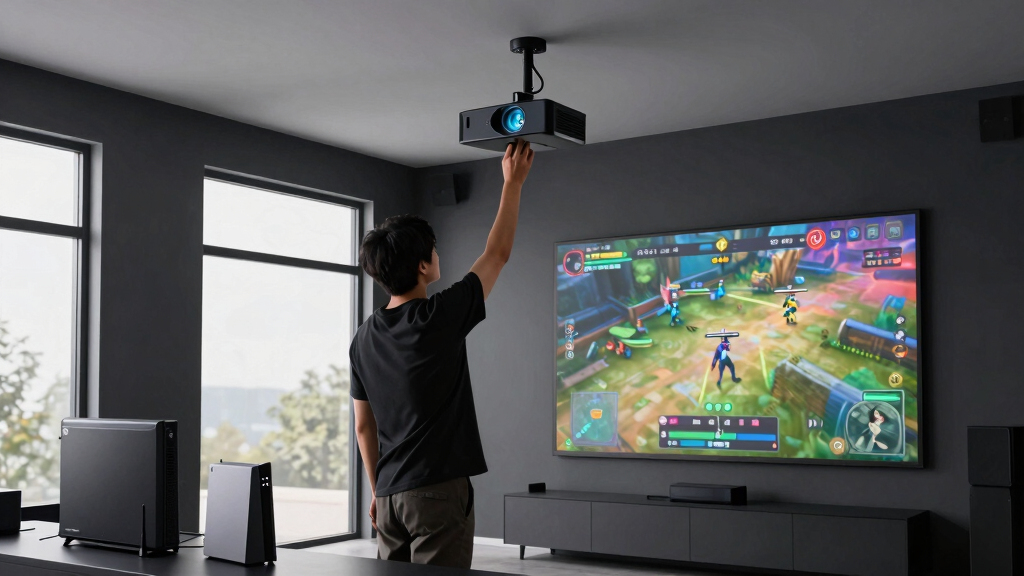
If I were building a gaming room around a short throw projector in 2026, I would start with the BenQ TK710STi because it combines 4K HDR detail with fast 1080p play. The Optoma GT2100HDR is the brighter laser choice for rooms that fight daylight, while the BenQ TH671ST is the simpler 1080p short throw pick when value and easy placement matter more than 4K.

Get games and gaming gear delivered free — and shop member deals
- Fast, free delivery on millions of items
- Access to Prime Big Deal Days deals on October 6–7
- Prime Video, Amazon Music and more included
The real decision is not resolution alone. A gaming room has to balance throw distance, input lag, ambient-light brightness, and screen size. I rank true short throw models above longer-throw alternatives because placement flexibility matters here, which is why the BenQ TH575 sits lower despite its strong brightness and low-lag gaming spec.
Key Takeaways
- I rank the BenQ TK710STi first because it is the only pick here with 4K HDR, laser projection, Android TV, and a listed 4ms response time at 1080p.
- The Optoma GT2100HDR is the brightness play, with 4200 lumens and laser light, but the missing input-lag figure makes it less clear for competitive gaming.
- The BenQ TH671ST is the most approachable true short throw pick for 1080p gaming rooms, especially around a 100-inch screen from 5 feet.
- The BenQ TH575 is not a true short throw projector, so I treat it as a bright budget alternative for deeper rooms rather than a direct short throw winner.
- For small rooms, throw distance should come before raw brightness; for shared rooms with lights on, brightness and laser life should move up the priority list.


| short throw projectors for gaming room | Brightness | Resolution | Best Gaming Strength |
|---|---|---|---|
| BenQ TK710STi 4K HDR Laser Sho | 3200 ANSI lumens | 4K HDR | 4K detail with fast 1080p mode |
| Optoma GT2100HDR Compact Short | 4200 lumens | 1080p HD | High brightness for day and night play |
| BenQ TH671ST 1080p Short Throw | 3000 lumens | Full HD 1080p | Easy large-screen 1080p setup |
| BenQ TH575 1080p Indoor Gaming | 3800 lumens | — | — |
More Details on Our Top Picks
BenQ TK710STi 4K HDR Laser Short Throw Projector with Android TV
I rank the BenQ TK710STi first because it solves more gaming-room problems at once than the other three. The 4K HDR resolution gives it a sharper ceiling than the 1080p BenQ TH671ST and Optoma GT2100HDR, while the listed 4ms response time at 1080p and 240Hz refresh rate make it the most convincing choice for fast games. Its 3200 ANSI lumens are not as high as the Optoma’s 4200 lumens, but the mix of detail, laser light, short throw placement, and Android TV makes it feel like the most complete centerpiece for a dedicated room.
The tradeoff is price and setup expectation. Compared with the BenQ TH671ST, this pick is less of a plug-and-play value choice and more of a premium build-around screen. Compared with the Optoma GT2100HDR, it gives better native detail but less listed brightness. I would skip it for a casual spare room where 1080p is enough, because its strongest advantages show up when the room, screen, and gaming hardware can make use of 4K HDR.
Pros:- 4K HDR resolution gives it the sharpest image potential in this lineup
- Listed 4ms response time at 1080p suits fast gaming
- 240Hz refresh support gives it the strongest speed story here
- Built-in Android TV makes it easier to use as a full entertainment hub
Cons:- Likely higher cost than the 1080p projectors
- 3200 ANSI lumens trail the Optoma GT2100HDR’s brightness rating
- Lamp or laser lifespan detail is limited in the provided specs
Best for: Console and PC players who want the most complete short throw gaming-room setup with 4K HDR and fast 1080p play.
Not ideal for: Budget buyers, casual players, or anyone who does not need 4K detail on a large screen.
- Resolution:4K HDR
- Brightness:3200 ANSI lumens
- Response Time:4ms at 1080p
- Refresh Rate:240Hz
- Color Coverage:95% Rec.709
- Operating System:Android TV
- Throw Type:Short throw
- Best Gaming Strength:4K detail with fast 1080p mode
Our verdict“This is my first pick for buyers who want a short throw projector to anchor a serious gaming room rather than just fill a wall.”
Optoma GT2100HDR Compact Short Throw Laser Home Theater and Gaming Projector, 1080p HD with 4K HDR Input, Bright 4,200 Lumens for Day and Night Viewing
The Optoma GT2100HDR is second because brightness is the problem many gaming rooms actually have: lamps, windows, wall colors, and people moving around during local multiplayer. Its 4200-lumen laser design gives it the highest listed brightness here, so it should hold up better than the BenQ TH671ST in mixed lighting and brighter than the BenQ TK710STi on paper. It also accepts 4K HDR input, which can simplify console setup, though the projected image remains 1080p.
I would choose this over the BenQ TH671ST for a brighter family room or day-and-night play space, and over the BenQ TH575 when short throw placement matters more than bargain brightness. The catch is that the limited supplied detail leaves gaps: no listed input-lag figure, no customer rating data in the brief, and no built-in smart platform like the TK710STi. For competitive players, that missing latency number keeps it behind BenQ’s premium model despite its stronger brightness rating.
Pros:- 4200-lumen brightness is the strongest rating in this group
- Laser light source is appealing for frequent gaming sessions
- Short throw compact design fits rooms where rear placement is awkward
- 4K HDR input support works well with modern consoles
Cons:- Native image is still 1080p rather than 4K
- Input-lag details are not included in the supplied specs
- External power supply may add clutter near the projector
Best for: Buyers who want a bright short throw laser projector for mixed-use gaming rooms with some ambient light.
Not ideal for: Competitive players who want a clearly listed input-lag number before buying.
- Resolution:1080p HD
- HDR Support:Yes
- Input Support:4K HDR
- Brightness:4200 lumens
- Light Source:Laser
- Design:Compact short throw
- Power Supply:External
- Best Gaming Strength:High brightness for day and night play
Our verdict“This is my pick for bright shared spaces, as long as 1080p output and missing latency detail are acceptable tradeoffs.”
BenQ TH671ST 1080p Short Throw Gaming Projector
The BenQ TH671ST is the easiest 1080p short throw recommendation because it gives a gaming room the thing many buyers came for: a big image without putting the projector at the back wall. Its 100-inch image from 5 feet is more room-friendly than the TH575, and its 92% Rec.709 color gives it a more cinema-minded profile than a barebones bright gaming projector. It lacks the 4K detail of the TK710STi and the laser brightness of the Optoma, but it hits the practical middle.
This is the model I would point toward for a first projector setup, especially if the screen will stay around 100 to 120 inches and the room can be dimmed. The built-in speaker helps with quick setup, while auto vertical keystone makes placement less fussy. Still, its 3000-lumen brightness asks for more light control than the Optoma, and buyers chasing high-refresh competitive play should move up to the TK710STi for the listed 240Hz and 4ms mode.
Pros:- True short throw design can create a 100-inch image from 5 feet
- 1080p resolution is a sensible match for value-focused gaming rooms
- 92% Rec.709 color coverage helps movies and games look more balanced
- Built-in speaker and auto vertical keystone simplify setup
Cons:- 3000 lumens are less forgiving in brighter rooms than the Optoma
- No 4K resolution for large-screen detail seekers
- Three-year warranty is good, but not a standout advantage over BenQ’s other listed model
Best for: First-time projector buyers who want a real short throw setup for 1080p console gaming and movie nights.
Not ideal for: Buyers who want 4K detail, laser brightness, or the fastest gaming spec in the lineup.
- Resolution:Full HD 1080p
- Brightness:3000 lumens
- Projection Size:Up to 300 inches
- Throw Distance:100-inch screen from 5 feet
- Color Accuracy:92% Rec.709
- Keystone:Auto vertical
- Audio:Built-in speaker
- Best Gaming Strength:Easy large-screen 1080p setup
Our verdict“This is the short throw value pick I would choose for a practical 1080p gaming room where easy placement matters most.”
BenQ TH575 1080p Indoor Gaming Projector, 3800 Lumens, Low Latency, Game-Mode, High Contrast, Dual HDMI, 3D Ready, Auto Vertical Keystone, Standard Throw, 1.1x Zoom, 3 Year Warranty
The BenQ TH575 is the outlier in this short throw roundup because it is listed as a standard throw projector, not a true short throw model. I still include it because its 3800 lumens, 16ms low-lag gaming, and 15000:1 contrast make it a sensible alternative for a deeper gaming room where the projector can sit farther back. Against the BenQ TH671ST, it trades placement freedom for brighter output and a likely value edge.
That tradeoff is exactly why it ranks fourth for this search. If the goal is a huge screen from a coffee table or front shelf, the BenQ TH671ST, Optoma GT2100HDR, and BenQ TK710STi all fit the short throw brief better. The TH575 makes more sense when room depth is available and low input lag matters more than a compact layout. I would skip it for apartments, small rooms, or clean console setups where projector placement needs to stay close to the screen.
Pros:- 3800 lumens give it strong brightness for the price class
- 16ms input lag is a clear gaming-friendly spec
- 15000:1 contrast can help dark scenes feel more readable
- Auto vertical keystone and dual HDMI add setup flexibility
Cons:- Standard throw design makes it the weakest fit for the short throw search
- Built-in speaker and audio details are not provided
- Weight and size details are limited in the supplied specs
Best for: Buyers with a longer gaming room who want bright 1080p projection and low input lag without paying for 4K.
Not ideal for: Small rooms, front-shelf setups, or buyers who specifically need true short throw placement.
- Native Resolution:1920 x 1080
- Brightness:3800 lumens
- Contrast Ratio:15000:1
- Display Type:DLP
- Input Lag:16ms
- Projection Distance:5 to 8 feet listed
- Maximum Image Size:300 inches
- Warranty:3 years
Our verdict“This is a strong low-lag 1080p alternative for deeper rooms, but it should not be mistaken for the best short throw choice.”

How We Picked
I ranked these projectors for a gaming room first, not for a generic home theater. My top weights were short-throw placement, input responsiveness, brightness under room lights, and whether the resolution holds up at larger screen sizes. That puts the BenQ TK710STi ahead because it gives the most complete gaming-room package, even though it is likely the pricier route.
I also separated true short throw models from a longer-room alternative. The Optoma GT2100HDR gets credit for its laser engine and 4200-lumen brightness, the BenQ TH671ST for easy 1080p short-throw setup, and the BenQ TH575 for low-lag brightness at a lower likely cost. I penalized vague specs, missing lifespan details, weak audio information, and any model that needs more room depth than a small gaming space can spare.
Factors to Consider When Choosing Best Short Throw Projectors For Gaming Rooms
I would narrow this category by room shape before getting pulled into spec-sheet battles. The best short throw gaming projector is the one that gives the screen size, speed, and brightness your room can actually support.
Start With Throw Distance
Throw distance decides whether a projector belongs in a small gaming room at all. The BenQ TH671ST is clear here because it can make a 100-inch screen from 5 feet, while the TK710STi and Optoma also fit the short throw idea. The TH575 has appealing gaming specs, but its standard throw design means I would only pick it when the room has enough depth for rear placement.
Match Brightness to the Room
Brightness matters most when the room doubles as a hangout space. The Optoma GT2100HDR has the highest listed output at 4200 lumens, making it the easiest fit for mixed lighting. The BenQ TH575 is also bright at 3800 lumens, but it loses short throw points. The BenQ TH671ST can work well in a dimmer room, while the TK710STi balances brightness with sharper 4K detail.
Input Lag Changes the Feel
For gaming, the image does not only need to look good; it has to respond quickly. The BenQ TK710STi has the strongest listed speed story with 4ms at 1080p and 240Hz, while the BenQ TH575 gives a useful 16ms figure for value-minded players. The Optoma GT2100HDR may still be fine for casual play, but without a supplied latency number, I would be more cautious if shooters or fighting games are the priority.
Decide Whether 4K Pays Off
4K HDR matters most when the screen is large enough for extra detail to show. That is why the BenQ TK710STi earns the top ranking for a serious gaming room. The 1080p models can still look satisfying at common screen sizes, especially for sports games, party games, and older consoles. I would only pay extra for 4K projection if the room and seating distance make the sharper image visible.
Treat Smart Features as Bonuses
Built-in apps and speakers can make setup cleaner, but they should not outrank the basics. The Android TV feature on the TK710STi is useful for streaming between game sessions, and the built-in speaker on the TH671ST helps beginners get started. For a dedicated gaming room, I would still plan around external audio, good HDMI access, and stable placement before letting smart features decide the purchase.
Frequently Asked Questions
Are short throw projectors good for gaming rooms?
Yes, a short throw projector can be a strong fit for a gaming room because it creates a large image without needing a long room. That helps with apartments, spare bedrooms, and front-of-room console setups where a standard projector would sit in the walking path or behind the sofa. I would still check input lag and brightness before buying, because short throw placement alone does not guarantee a responsive or bright gaming image.
Which projector in this list is best for competitive gaming?
My pick for competitive gaming is the BenQ TK710STi because it has the strongest listed response spec, with 4ms at 1080p and 240Hz refresh support. The BenQ TH575 also has a useful 16ms low-lag figure, but it is not a true short throw model. I would be more careful with the Optoma GT2100HDR for competitive play because the supplied details do not include a specific latency number.
Is 4K worth it for a short throw gaming projector?
4K is worth paying for when the screen is large, the seating distance is close enough to reveal detail, and the gaming hardware can feed a strong 4K signal. That is why I rank the BenQ TK710STi above the 1080p options for a serious room. If the setup is closer to casual multiplayer, older consoles, or a smaller 100-inch screen, a 1080p short throw model like the BenQ TH671ST may be the smarter spend.
How many lumens do I need for a gaming-room projector?
For a dim room, 3000 lumens can be enough, which keeps the BenQ TH671ST in the mix for value-focused buyers. For rooms with lamps, windows, or people moving in and out, I would lean toward higher brightness, such as the Optoma GT2100HDR at 4200 lumens or the BenQ TH575 at 3800 lumens. Brightness still cannot fix every setup issue, so screen choice and light control matter too.
Should I choose a laser or lamp projector for gaming?
I prefer laser projectors for frequent gaming rooms because they are usually easier to live with over time and suit quick daily use. That helps the BenQ TK710STi and Optoma GT2100HDR stand out. A lamp-based projector can still make sense when price matters, which is where the BenQ TH671ST and TH575 remain appealing, but I would factor in lamp life, replacement cost, brightness needs, and how often the room will be used.
Conclusion
For the strongest all-around gaming room, I would buy the BenQ TK710STi; it is the best match for buyers who want 4K HDR, fast 1080p play, short throw placement, and built-in streaming. For a bright shared room, I would move to the Optoma GT2100HDR, accepting 1080p output in exchange for the highest listed brightness and laser convenience.
For a first short throw projector, I would choose the BenQ TH671ST because it makes a large 1080p screen easy without overcomplicating the room. The BenQ TH575 is my budget-minded longer-room fallback, not my first short throw pick, but it makes sense when brightness and low lag matter more than placing the projector close to the screen.
Fall Picks
fall essentials
As an affiliate, we earn on qualifying purchases.