
TL;DR
An XDA Developers contributor says a GTX 1080 Ti still runs the games he regularly plays on a second PC, with lower settings and upscaling helping in some newer titles. The account describes desktop gaming, not VR: it gives no headset, VR game, frame-rate, or compatibility results, so it does not establish how the card performs for VR in 2026.
An XDA Developers contributor says a GTX 1080 Ti remains usable for games he regularly plays on a second PC, nine years after the card launched. But despite the topic’s reference to VR, the account reports no virtual-reality testing: it identifies no headset or VR title and gives no VR frame-rate or compatibility results.

Play games on Amazon Luna for your game nights, included with Prime
- A rotating selection of games, no download needed
- Play on TV, laptop or phone
- Fast, free delivery for your gear, too
The contributor describes using the older PC during occasional visits to his parents’ home. He upgraded its processor by moving a Ryzen 7 5800X3D into the system after installing a newer processor in his main PC, and says the change improved the system’s 1% lows. That CPU upgrade does not add graphics features or remove the GTX 1080 Ti’s limitations.
For demanding desktop games, he starts at 1080p with low settings and adjusts based on frame rates monitored with MSI Afterburner. He says the card’s 11GB of VRAM can allow higher texture settings, while he keeps demanding effects such as shadows, reflections and volumetric effects low. In supported games, he uses AMD FSR 3.1; for games without native support, he says he turns to Lossless Scaling or OptiScaler.
His examples are conventional PC games, not VR titles. He reports around 80 frames per second in Battlefield 6 at 1440p on low settings, without upscaling or frame generation, and says he prefers 1080p for multiplayer games when targeting more than 100 FPS. Those figures are his reported experience on his system, not independently verified results or a guarantee for other PCs.
GTX 1080 Ti in 2026 What the report tells us
An XDA Developers contributor still uses the card for selected desktop games. The account provides no evidence of VR performance or compatibility.
How he uses the card
His experience is with selected desktop games on a secondary PC.
He begins demanding games at low settings and adjusts based on observed frame rates.
He says 11GB of VRAM can allow higher texture settings while demanding effects stay low.
He reports using FSR 3.1 where supported, or Lossless Scaling and OptiScaler in some other games.
Where the limits appear
The card lacks hardware ray tracing and DLSS, and some newer games require ray-tracing hardware.
- Valorant
- Battlefield 6
- Selected familiar games
- Indiana Jones and the Great Circle
- DOOM: The Dark Ages
- Games requiring ray-tracing hardware
Desktop results are personal
The contributor reports around 80 FPS in Battlefield 6 at 1440p on low settings, without upscaling or frame generation. He prefers 1080p for multiplayer when targeting more than 100 FPS.
The VR question remains open
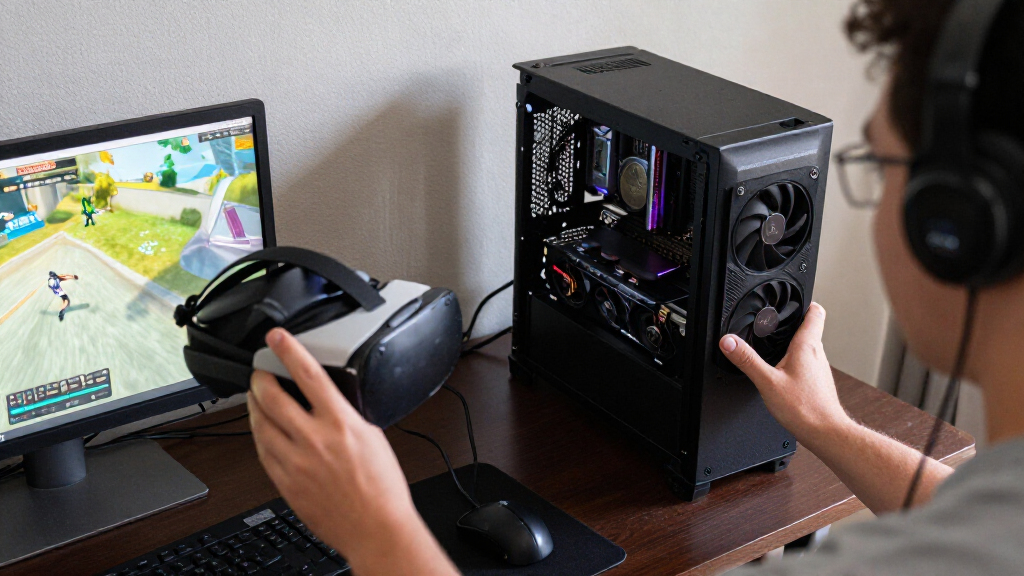
The account names no headset or VR title and reports no VR frame rates, compatibility results, or headset-specific testing.
- Check requirements for your chosen headset and games.
- Look for tests using the same setup.
- Do not treat desktop performance or upscaling as proof of VR suitability.
What the Experience Says About VR
The account may interest owners deciding whether to keep an older graphics card, but it does not answer the VR question. VR workloads and headset requirements are not assessed in the article, and desktop performance figures cannot establish whether a particular headset and VR game will run smoothly. The reported use of FSR and frame generation also does not demonstrate that those techniques work or are suitable in VR.
For readers considering a GTX 1080 Ti for VR, the practical takeaway is to treat the account as evidence of continued use for selected flat-screen games, not as a VR recommendation. Compatibility and performance would need to be checked for the specific headset, title, resolution and system configuration.
Popular right now

KitchenAid Classic Series 4.5-Quart Tilt-Head Stand Mixer, Onyx Black

Ninja Foodi DZ401 DualZone XL Air Fryer, 10 Qt, 6-in-1, Grey

De'Longhi Classic Signature Espresso Machine with Adjustable Milk Frother
As an affiliate, we earn on qualifying purchases.
A 2017 Card Meets Newer Games
The GTX 1080 Ti launched in 2017, before Nvidia introduced hardware-accelerated ray tracing with its RTX 20-series cards. The contributor says the 1080 Ti lacks hardware ray tracing and DLSS, leaving him to lower graphics settings or use other upscaling options when a game supports them. He also notes that some games, including Indiana Jones and the Great Circle and DOOM: The Dark Ages, require a GPU with ray-tracing hardware and will not run on the card.
His reported use is deliberately limited: he keeps the GPU in a secondary PC for familiar games rather than expecting it to run every new release. He says titles such as Valorant and Battlefield 6 remain part of his routine, while acknowledging that compatibility limits may grow. The article’s reference to performance comparable to an RTX 3060 12GB is the contributor’s assessment, not a new benchmark supplied with test details.
““1080p is what I consider the sweet spot for this GPU.””
— The XDA Developers contributor
VR Performance Was Not Tested
The report does not say whether the GTX 1080 Ti was tested with any VR headset or VR game. It provides no headset model, headset resolution, frame-rate measurements, frame pacing results, settings, or VR compatibility information. There is also no stated test methodology for the desktop performance figures, so they should be read as the contributor’s personal results rather than controlled benchmarks.
It is also unclear which future games will stop supporting the card. The contributor expects the list of titles requiring ray-tracing hardware to grow, but gives no timetable or count. Nothing in the account establishes how long the card will remain suitable for a particular user’s games.
Check Headset and Game Requirements
Readers considering the card for VR will need to check the minimum and recommended requirements for their chosen headset and titles, then look for tests using the same setup. The reported desktop figures may help set expectations for ordinary PC gaming, but they cannot substitute for VR-specific measurements.
The contributor says he plans to keep using the GPU until games he wants to play require an upgrade. No replacement date is given. Any future change will depend on the games he chooses and the cost of upgrading his main PC.
Key Questions
Does this report show that a GTX 1080 Ti can run VR games in 2026?
No. It reports no VR tests, headset details, VR titles or headset-specific performance results. It describes desktop gaming only.
What settings does the contributor use on the GTX 1080 Ti?
For demanding games, he starts at 1080p and low settings, then adjusts based on observed frame rates. He says he may raise texture quality because the card has 11GB of VRAM.
Which upscaling tools does he say he uses?
He uses FSR 3.1 in supported games and says he uses Lossless Scaling or OptiScaler when native support is unavailable or a game only supports DLSS. This is his reported desktop setup, not a VR recommendation.
What newer games does the contributor say the card cannot run?
He names Indiana Jones and the Great Circle and DOOM: The Dark Ages as examples of games that require hardware-accelerated ray tracing, which the GTX 1080 Ti lacks.
Is the contributor planning to replace the card?
Not immediately, according to the account. He says he will consider upgrading when games he wants to play force the issue, but gives no replacement timeline.
Source: XDA Developers