
TL;DR
A Soulslike is an action game shaped by deliberate combat, consequential death, checkpoint-based progress, repeated learning, and hostile but readable encounters, following ideas popularized by FromSoftware. Treat the term as a cluster of related features, not a purity test: a game can change combat, storytelling, difficulty options, or world structure while keeping the central learning loop.
A heavy door groans open, cold wind spills into the corridor, and something enormous starts dragging a blade across the stone. You attack too early, hear the flat clang of steel, and wake beside the last checkpoint with your currency sitting in the boss room. That short sequence tells you more about a Soulslike than any argument about difficulty, dodge rolls, or developer pedigree.

Play games on Amazon Luna for your game nights, included with Prime
- A rotating selection of games, no download needed
- Play on TV, laptop or phone
- Fast, free delivery for your gear, too
You can recognize this style without building a fence around it. A Soulslike is best understood as a cluster of related features: deliberate actions, meaningful failure, repeating checkpoints, learnable danger, and progress driven by both character upgrades and your own knowledge. The label describes a design lineage, not a medal awarded to games that make you suffer.
This guide gives you a practical way to spot that lineage, compare nearby genres, and discuss disputed games without starting a genre war. You will see why Demon’s Souls in 2009 and Dark Souls in 2011 matter, why Sekiro creates debate, and why summons or assist settings do not erase the underlying structure. The goal is simple: describe what the game asks you to learn and how its systems work together.
Identify a Soulslike by the way deliberate combat, death, checkpoints, exploration, and learning work together—not by one feature such as rolling or high diffi…
Describe disputed games as Souls-inspired when they borrow part of the structure; this says more than forcing every edge case into a yes-or-no category.
Treat death as useful only when it provides readable information that improves your next attempt.
Use summons, shields, magic, cooperative play, and assist settings when they suit you; tools supplied by the game are valid parts of its design.
Ask which systems shape most of the experience and what the game changes from the FromSoftware lineage.
Genre field guide / no gatekeeping
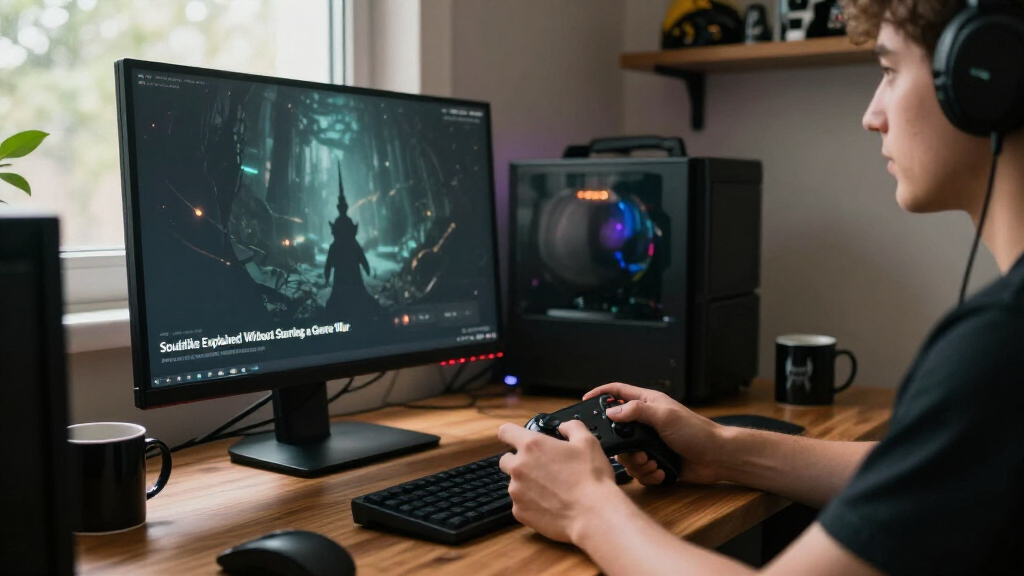
Soulslike Explained Without Starting a Genre War
A Soulslike is an action game shaped by deliberate combat, consequential death, checkpoint-based progress, repeated learning, and hostile but readable encounters. Think of the term as a cluster of connected ideas—not a purity test.
01 / Pattern recognition
The five features that make the label useful
A stamina bar, bonfire, boss, or dodge roll proves very little alone. The strongest signal is the way combat, failure, checkpoints, exploration, and mastery reinforce one another across most of the experience.
Committed actions
Attacks, dodges, blocks, healing, and items take time. Once an action begins, spacing and timing determine whether the choice succeeds.
Consequential death
Death costs position, time, or stored currency. Recovering what was lost creates a fresh decision: push deeper or retreat to safety.
Resetting checkpoints
Rest restores supplies but usually revives ordinary enemies. Reaching the next safe point becomes a meaningful expedition.
Layered exploration
Doors, elevators, ladders, and hidden routes fold danger back onto itself. A newly opened shortcut can matter more than a stronger weapon.
Hostile but readable encounters
A raised shoulder, scraping blade, or half-second pause becomes information. Your character improves, but the decisive upgrade is often what you have learned.
02 / Death as tuition
Failure works when the next attempt contains a better answer
The signature rhythm is not simply “die often.” It is a repeatable cycle in which danger produces information and information gradually creates control.
Explore
Leave safety with currency, supplies, and an incomplete map.
Meet resistance
An enemy, trap, or boss exposes a gap in your plan.
Lose or retreat
Pay with time, position, resources, or pride.
Adjust
Change timing, equipment, route, or expectations.
Try again
The same hallway feels shorter because its dangers are known.
Readable failure teaches. Repeatable tells, consistent rules, safer routes, and clear recovery windows turn punishment into mastery. Confusing hitboxes or long empty walks merely consume time.
03 / Nearby genres
Shared ingredients, different recipes
Several genres borrow the same mechanics. Classification becomes useful only when you ask which systems dominate the whole game, rather than counting isolated props.
| Design signal | Soulslike | Roguelike | Metroidvania | Character action |
|---|---|---|---|---|
| Committed combat | ✓ | ~ | ~ | ~ |
| Death feeds learning | ✓ | ✓ | ~ | ~ |
| World resets at rest | ✓ | ~ | ✗ | ✗ |
| Recoverable currency | ✓ | ~ | ✗ | ✗ |
| Layered route discovery | ✓ | ~ | ✓ | ✗ |
| Execution-focused mastery | ✓ | ~ | ~ | ✓ |
✓ Usually central ~ Common or variable ✗ Usually not central
04 / Signal strength
Core structure versus familiar decoration
The bars show relative diagnostic value, not a mandatory score. A game may alter any single feature and retain the lineage if the central learning loop remains intact.
05 / The edge-case protocol
Replace the purity test with a spectrum
Games such as Sekiro create debate because they preserve major parts of the learning structure while changing builds, defense, movement, and role-playing systems. “Souls-inspired” is often more informative than forcing every edge case into a binary answer.
A practical vocabulary
Identify which connected systems shape most of the experience.
Describe what the game preserves, replaces, or removes from the lineage.
Use the narrowest label that communicates expectations without policing legitimacy.
06 / Traceability chain
What the player actually experiences
Summons, shields, magic, cooperative play, ranged builds, and assist settings are valid tools supplied by the game. Their presence does not erase the underlying structure.
Play the designThe Five Features That Make the Soulslike Label Useful
Soulslike Explained Without Starting a Genre War means looking for several connected systems, not one familiar prop. The strongest signal is a loop where committed combat, costly mistakes, checkpoints, exploration, and learning reinforce one another. A bonfire or stamina bar alone tells you almost nothing about the full experience.
- Committed actions: Attacks, dodges, blocks, healing, and item use take time. Pressing a button feels like swinging a heavy workshop hammer: once the head starts moving, you must live with its path.
- Consequential death: Failure costs position, time, or stored currency. Many games let you recover that currency by returning to the place where you fell.
- Resetting checkpoints: Rest restores your supplies but brings ordinary enemies back. Safety has a price, so reaching the next lamp, shrine, or resting place feels like stepping into warm light after rain.
- Layered exploration: Ladders, doors, elevators, and hidden passages fold a dangerous area back onto itself. Opening a shortcut can matter more than finding a stronger sword.
- Mastery-driven encounters: Enemies look brutal at first, but their tells become readable. A raised shoulder, scraping claw, or half-second pause eventually warns you more clearly than a flashing tutorial prompt.
Imagine reaching a knight at the end of a narrow bridge. On your first attempt, you roll backward and fall; on the second, you discover that its shield bash leaves one safe opening; on the third, you reach the checkpoint with one healing flask left. Your character may barely change, but you have changed, and that personal learning is central to the formula.
According to the skeldrift.com Gaming Glossary [1], challenge matters because decisions carry consequences, not because every enemy has a swollen health bar. In simpler words, the game makes your choices heavy. A weakly balanced action game can be punishing, but a Soulslike turns failure into usable information and repetition into progress.
Popular right now

Bose QuietComfort Headphones – Wireless Bluetooth Over-Ear Noise Cancelling Headphones, Petal Pink Limited Edition

Hisense 40-Inch QD4SR Series Hi-QLED FHD Roku Smart TV

Vitamix Touch & Go Advance 32-Ounce Bar Blender, White
As an affiliate, we earn on qualifying purchases.
Why Death Feels Like Tuition Instead of a Dead End
Soulslike Explained Without Starting a Genre War requires separating punishment from learning. Death usually removes your current position and may put earned currency at risk, yet it preserves knowledge about attacks, traps, routes, and timing. You pay for the lesson, then return with a better answer.
- Explore: You push beyond safety while collecting currency, items, and clues about the route.
- Meet resistance: An enemy, trap, or boss exposes a gap in your plan.
- Lose or retreat: You die, return to a checkpoint, or decide to spend what you have.
- Adjust: You change your timing, equipment, route, or expectations.
- Try again: The same hallway now feels shorter because you know where danger waits.
That cycle works like learning a song on guitar. The first run is a jumble of missed notes; the next teaches your fingers where to move; eventually the chord change arrives without conscious effort. In a Soulslike, the rattling chain above a doorway or the empty corner beside a treasure chest becomes a warning because repetition builds recognition and recognition creates control.
A corpse run adds a sharp risk decision. Suppose you die while carrying enough currency for two levels, then recover it halfway through the next attempt. You can push toward an unknown elevator or turn back and spend it; that choice gives the currency emotional weight beyond its numerical value and makes retreat a valid tactic.
Death only supports good Soulslike design when the next attempt teaches you something. Confusing hitboxes, inconsistent rules, or a long empty walk can create irritation without creating mastery.
This distinction explains why frequent failure can feel fair in one game and hollow in another. A good encounter leaves evidence: a sound before the ambush, a repeatable recovery window, or a safer route you missed. The world remains hostile, but it becomes more readable with every visit, like ink slowly appearing on an old map.
What the Label Promises—and What It Never Guarantees
Soulslike Explained Without Starting a Genre War gives you useful expectations, not a guarantee that every familiar feature will appear. You can reasonably expect deliberate choices, repeated learning, and pressure between safe points. You cannot assume dark fantasy, a dodge roll, obscure storytelling, or extreme difficulty from the label alone.
| Feature | What it may suggest | Why it proves little alone |
|---|---|---|
| High difficulty | Mistakes demand attention | Arcade shooters and platformers can be harder without using the Souls loop |
| Boss fights | Major skill checks | Bosses appear across action games, RPGs, and adventures |
| Dodge rolling | Timed, position-based defense | Some Soulslikes favor shields, deflection, jumping, or ranged movement |
| Dropped currency | Risk after death | The recovery trip must connect meaningfully to progression and level structure |
| Cryptic lore | Story discovered through fragments | Direct storytelling can sit beside strongly Soulslike combat and checkpoints |
Consider a difficult character-action game built around long aerial combos, instant animation cancels, and mission rankings. It may feature towering bosses and punishing mistakes, yet its combat feels like jazz improvisation: fast, expressive, and open to mid-phrase changes. Soulslike combat more often resembles chess played with a blade, where commitment closes options and position shapes every exchange.
The same distinction helps with Metroidvanias and roguelikes. A Metroidvania usually gates exploration behind new abilities, such as a double jump that opens a ledge you passed two hours earlier. A roguelike commonly resets a run and rearranges content, while a Soulslike usually preserves the world’s basic layout and much of your character’s lasting progress.
Hybrids can belong to multiple families at once. Nine Sols, for example, combines two-dimensional ability-gated exploration with deflection-focused battles and punishing checkpoints. Calling it both a Metroidvania and Souls-inspired communicates more than forcing it into one spotless box.
The Short History That Explains FromSoftware’s Influence
Soulslike Explained Without Starting a Genre War starts with one historical distinction: FromSoftware did not invent every ingredient, but it combined them into a structure other studios could recognize and adapt. Demon’s Souls established much of that formula in 2009, and Dark Souls carried it to a larger international audience in 2011 [2].
Think of the process like a cook creating a signature stew. No single ingredient—checkpoints, hard enemies, RPG statistics, lost currency, or looping maps—was new. The recipe became influential because those pieces flavored one another: death changed exploration, checkpoints changed resource use, and shortcuts changed how you remembered space.
Later FromSoftware games adjusted that recipe. Bloodborne pushed you toward aggression with faster movement and health recovery through counterattacks, while Sekiro: Shadows Die Twice centered combat on posture, deflection, and a comparatively fixed hero. Elden Ring spread many of the same principles across a large open world, where you could leave a stone-skinned boss, ride through golden grass, and return after finding another weapon or summon.
Elden Ring also showed that Souls-inspired design could reach far beyond its earlier niche. Its broad selection of builds, cooperative options, spirit summons, and optional exploration gave players many ways to manage difficulty. The 2024 expansion Shadow of the Erdtree renewed arguments about boss speed, progression, summons, and increasingly elaborate attack patterns.
The phrase popularized by FromSoftware is more accurate than saying the studio created difficult games from nothing. That wording gives credit without erasing older action RPGs, arcade traditions, or games with corpse-recovery systems. It also leaves room for newer developers to add their own bright colors, strange tools, and different rhythms.
Why Sekiro, Remnant II, and Other Edge Cases Still Make Sense
A disputed game can be substantially inspired by Souls design without copying every feature. The useful question is how much its combat, death, checkpoints, exploration, and mastery loop depend on that lineage. Edge cases do not break the term; they reveal that genres are families with overlapping traits, not sealed containers.
Sekiro is the cleanest example. It has resetting checkpoints, dangerous routes, consequential death, imposing bosses, indirect story details, and repeated attempts built around observation. Yet its named protagonist, limited build variety, and posture-based sword fights differ from the broad character construction associated with Dark Souls, so some players call it Soulslike while others place it beside the category.
Remnant II changes the feel even more by mixing Souls-inspired encounters with third-person shooting and procedurally assembled areas. One moment you are circling a creature while rifle shots crack through dusty air; the next you are studying a boss pattern and rationing healing charges. The guns change how you control distance, but the game retains pressure, repetition, and adaptive learning.
Other games bend different parts of the formula. Lies of P uses weapon assembly and guarding in a dark Pinocchio setting, while Another Crab’s Treasure swaps gray ruins for a colorful underwater world and offers extensive assist options. Wo Long: Fallen Dynasty emphasizes rapid deflection and morale, and Lords of the Fallen builds exploration around two connected versions of its world.
Age ratings and content labels vary by region, platform, and version, even when two games share the same genre tag. Check the current storefront or rating board if blood, horror imagery, or online interaction matters in your household. A bright shell and turquoise water can signal a lighter mood, but art style alone does not tell you the game’s difficulty or age suitability.
A 60-Second Test That Ends Most Genre Arguments
You can test whether a game is Soulslike by asking five practical questions about its full structure. Count patterns, not props: the label fits when several Souls-inspired systems shape most of your play. This method produces a clear description even when the final yes-or-no answer remains fuzzy.
- Do actions demand commitment? Look for attacks, healing, defense, or items that expose you when timed badly.
- Does death feed the next attempt? Check whether you lose position or resources while keeping knowledge and meaningful progress.
- Do checkpoints create pressure? Resting should affect enemies, supplies, routes, or the decision to continue.
- Does exploration reward memory? Shortcuts, loops, hazards, and enemy placement should become easier to read.
- Do major fights test learned skills? Bosses should ask you to apply timing, spacing, defense, resource control, or build choices.
Try the test on Elden Ring. It receives a clear yes across the list: attacks carry commitment, death can start a recovery trip, Sites of Grace structure progress, dungeons reward route knowledge, and bosses test skills learned across the journey. Its open fields alter the travel pattern, but the central loop remains intact.
Now try it on a hard action game with bosses and rolling but no meaningful checkpoint pressure, persistent route learning, or death-recovery system. You may find two yes answers and three weak ones. Calling it Souls-inspired tells your friend more than declaring it either a pure Soulslike or a fraud.
Replace “Is this a real Soulslike?” with “Which Souls-inspired systems shape the experience, and what does the game change?”
This framing also helps when a store page uses the label loosely. Instead of assuming you will enjoy the game because it shows a huge armored knight, check whether you actually like committed combat, repeated route learning, build planning, or corpse runs. Genre words work best when they help you choose, explain, and compare.
Why Summons and Assist Modes Do Not Cancel the Formula
Summons, cooperative play, and adjustable settings do not automatically stop a game from being Soulslike. The stronger test is whether the game still asks you to observe, adapt, and improve inside its core loop. Difficulty changes the intensity of that process; it does not single-handedly define the design tradition.
Imagine fighting a towering beast whose claws rake sparks from a stone floor. Alone, you must control every opening; with an AI companion, the creature splits its attention and gives you longer healing windows. You still read attacks, manage resources, cross the same dangerous space, and recover from mistakes, but the pressure changes shape.
Build-focused games often provide magic, shields, ranged weapons, status effects, consumables, summons, and cooperative partners on purpose. Using those tools is no more dishonest than choosing a spear because its reach keeps you outside a knight’s sword arc. A self-imposed no-summon run can be rewarding, but it remains a personal challenge rule, not a genre law.
Assist features can also preserve the learning loop while reducing a specific source of friction. Lower incoming damage may give you time to recognize a three-hit pattern; a wider parry window may let you hear the metallic snap of successful timing before practicing a stricter setting. The player still gathers information and applies it, which keeps mastery meaningful.
Bad difficulty exists, too. An unreadable attack, unreliable camera, or tedious return trip does not become clever merely because it causes deaths. When judging a game, ask whether its challenge produces clear feedback, allows different valid tactics, and makes later attempts feel more informed than the first.
Frequently Asked Questions
What is the simplest definition of a Soulslike?
A Soulslike is an action game built around deliberate combat, consequential death, checkpoint-based progress, repeated learning, and demanding but readable encounters. It follows a design lineage established by Demon’s Souls and brought to a wider audience by Dark Souls.
Does a Soulslike have to be extremely difficult?
No. Challenge matters because it creates pressure and learning, but the absolute difficulty can vary. A moderately demanding game can fit when checkpoints, resource choices, recovery after death, and adaptation across attempts shape the experience.
Is Sekiro: Shadows Die Twice a Soulslike?
Sekiro shares resetting checkpoints, consequential death, demanding bosses, indirect story details, and a mastery-driven structure with other Soulslikes. Its fixed hero, narrower build choices, and posture-based deflection make it an edge case, so describing those differences is more useful than demanding one universal ruling.
Are summons or cooperative play the wrong way to beat a boss?
No. If a game supplies summons, cooperative play, magic, shields, or consumables, those options form part of its mechanical vocabulary. Avoiding them can create a satisfying personal challenge, but using them does not invalidate your victory or remove the game’s Soulslike structure.
What is a good first Soulslike for a beginner?
Elden Ring offers open exploration, many builds, summons, and opportunities to leave a hard fight temporarily. Another Crab’s Treasure provides assist features, while Star Wars Jedi: Fallen Order pairs adjustable difficulty with a more direct story; check the current platform, version, and regional age rating before buying.
Conclusion
Remember one idea: a Soulslike is a design family, not a suffering contest. When deliberate choices, costly failure, checkpoint pressure, route learning, and earned mastery hold the experience together, the label gives you useful information—even if the game replaces swords with rifles, gray castles with coral reefs, or solo combat with a helpful companion.
The next time an argument starts over whether a game counts, skip the courtroom language. Name the mechanics, explain how they interact, and say where the game changes the familiar pattern. You will leave with a clearer description—and perhaps enough time to open that groaning door for one more attempt.