
TL;DR
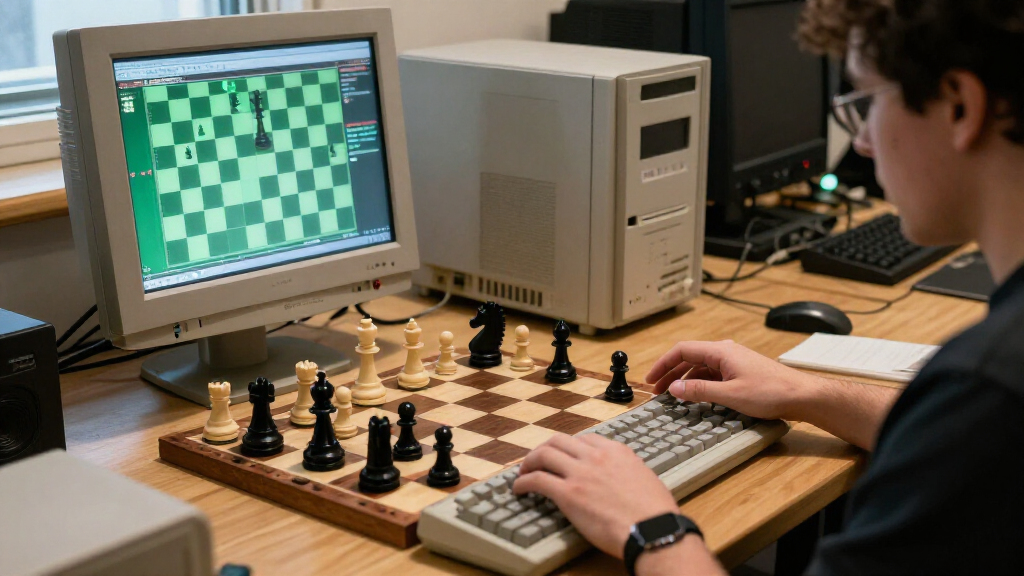
A 2026 report describes a modern Stockfish engine adapted to a 200 MHz Pentium Pro, with an estimated rating of 3,180 Elo at 30 seconds per move. The result suggests that advances in chess-engine design could have made 1996 hardware far stronger than the software of the time, but no Kasparov match was played, and the rating does not prove how such a machine would have performed in a historical match.
A 2026 report says a modern Stockfish chess engine, adapted to run on a 200 MHz Intel Pentium Pro, reached an estimated 3,180 Elo at 30 seconds per move—a result that supports the idea that better software could have made 1996 computers much stronger. But the experiment did not pit the engine against Garry Kasparov, so it does not establish that a Pentium-based program would have beaten him in a match.

Play games on Amazon Luna for your game nights, included with Prime
- A rotating selection of games, no download needed
- Play on TV, laptop or phone
- Fast, free delivery for your gear, too
The experiment’s author ran a custom Stockfish port on a Pentium Pro with 64 MB of RAM. The processor, released in 1995, is a 32-bit machine, so the port required changes to Stockfish’s code and memory use. The author then adjusted and tuned the engine for the older hardware, reporting estimated ratings of 2,846 Elo at one second per move, 3,109 at 10 seconds and 3,180 at 30 seconds. These are test estimates, not results from games against Kasparov.
The report also compares the adapted engine with older software. In a 100-game match, the modern engine running on the Pentium Pro scored 78 wins, 17 draws and five losses against the 1996 version of Crafty running on modern hardware. That finding illustrates how much contemporary engine methods can matter even when the processor is old. It does not show the outcome of a 1996 human-versus-computer match.
To test the effect of software improvements separately, the author updated Crafty with later search and evaluation techniques, including neural-network evaluation. On the Pentium Pro, the updated version reached an estimated 2,718 Elo at one second per move and 2,974 at 10 seconds. The report estimates that better programming accounts for 720 of the 1,335 Elo points separating its comparison of older commodity engines and modern Stockfish; that attribution depends on the author’s test design and rating estimates.
Software Gains on Old Hardware
The result complicates the assumption that Deep Blue’s specialized hardware was the only route to a computer capable of challenging a world champion. The report’s experiments suggest that search methods and position evaluation developed over time can produce substantial strength gains on a processor from the mid-1990s. That matters to readers because it separates two sources of progress often treated as one: faster computers and better chess programs.
It does not make Deep Blue’s achievement less real. IBM’s system was purpose-built and, in February 1996, became the first computer program to defeat the reigning world champion in a game. Kasparov won that six-game match, while Deep Blue won their 1997 rematch. The new experiment is a retrospective comparison, not a revision of those match records. Its main implication is narrower: with later software knowledge, a commodity-era processor may have been capable of far stronger play than contemporary programs achieved.
Popular right now

Dyson Purifier Cool PC2 De-NOx

De'Longhi Stilosa Compact Manual Espresso Machine with Milk Frother

Sony WH-1000XM6 Wireless Noise-Canceling Headphones, Black
As an affiliate, we earn on qualifying purchases.
Deep Blue and the 1996 Match
On Feb. 10, 1996, IBM’s Deep Blue defeated Kasparov in an individual game, the first time a computer program had beaten the reigning world champion in a game. Kasparov won the match. Deep Blue’s upgraded system then beat him 3.5–2.5 in 1997. The source report says the later machine used 30 processors running at roughly 120 MHz alongside 480 custom chess co-processors, which handled tasks such as move generation and position evaluation.
Chess programs combine the ability to search many possible moves with methods for choosing which positions to examine and judging their value. The report contrasts older commodity-era software, estimated at roughly 2,300 Elo, with modern Stockfish, estimated there at about 3,700 Elo. Elo ratings estimate relative playing strength; they do not guarantee a particular result in a short match, and values from separate tests can vary with time controls, opponents and testing methods.
The Kasparov Match Was Not Tested
The central counterfactual remains unanswered by direct evidence: the report does not describe a match between its Pentium-based engine and Kasparov, nor does it recreate the conditions of the 1996 match. An estimated Elo rating indicates expected strength across a test pool, but it cannot establish the outcome of a particular match without details about opponents, time controls, match length and other conditions.
The report’s supplied figures are estimates with stated uncertainty ranges for several tests. The available material does not provide enough detail here to independently assess every rating calculation or determine how the adapted engine would perform under the exact rules and preparation used against Kasparov. The conclusion that it would “almost certainly” have beaten him is the author’s claim, not a confirmed historical result.
More Testing Would Narrow the Gap
The report describes experiments comparing engine versions, hardware and time controls; it does not announce a scheduled Kasparov test or a new competition. The next useful evidence would be detailed, repeatable testing against strong human players or a carefully specified simulation of the 1996 match conditions, with the time control, hardware limits and engine settings published.
Until then, the supported conclusion is that modern chess-engine techniques can produce powerful play on a Pentium Pro, and that software improvements account for a large share of the gains in the report’s comparisons. Whether that particular engine would have beaten Kasparov in 1996 remains a counterfactual rather than a demonstrated outcome.
Key Questions
Did the Pentium-based engine play Kasparov?
No. The report tests the engine against other computer software and estimates its Elo; it does not report a match against Kasparov.
What hardware did the experiment use?
The author says the machine used a 200 MHz Intel Pentium Pro with 64 MB of RAM. The Stockfish port was modified for the processor’s 32-bit architecture and limited memory.
How strong was the adapted Stockfish?
The report estimates 3,180 Elo at 30 seconds per move, with lower estimates at shorter time controls. Elo is a rating estimate, not a guaranteed result against a specific opponent.
What did Deep Blue achieve in 1996?
Deep Blue beat Kasparov in one game on Feb. 10, 1996, but Kasparov won their match. Deep Blue defeated him in their 1997 rematch.
Source: nicholas.carlini.com