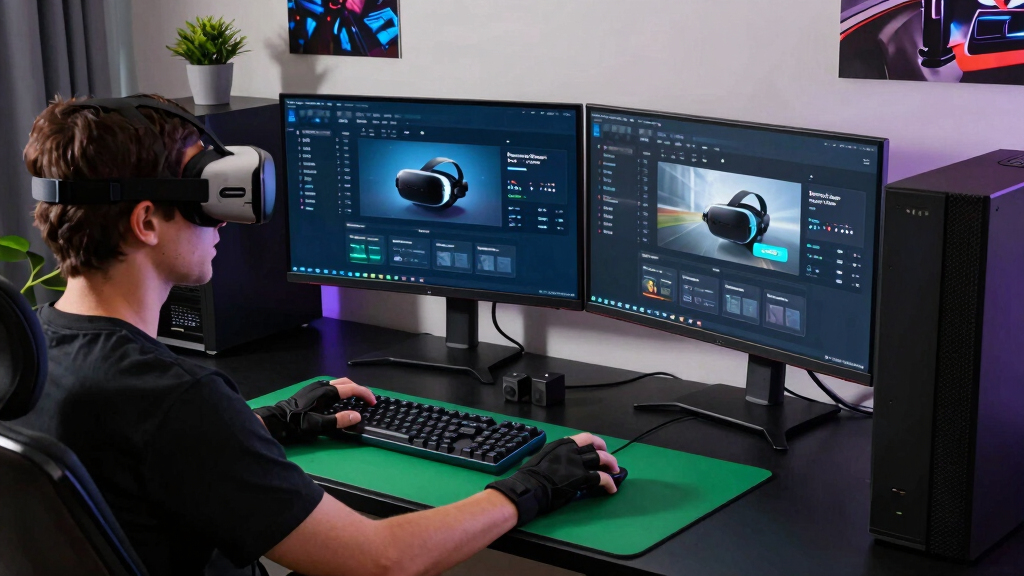

TL;DR
OpenXR is the shared language that lets VR games talk to headsets through a runtime instead of separate hardware-specific APIs. For Steam Frame and PC VR players, it matters because SteamVR can act as the OpenXR runtime, but your headset, game, drivers, and store badge still decide what actually works [1].
The dull little runtime setting in SteamVR can decide whether your VR game opens like a clean glass door or smacks into a wall.
OpenXR sounds like plumbing because, honestly, it is. Good plumbing. You do not admire it while playing, but you notice fast when it leaks: black screens, wrong controllers, floating hands, or a game that launches on your monitor instead of your headset.
You will get an overview suitable for Steam players who want clear answers: what OpenXR does, why Steam Frame and PC VR players should care, and which settings matter before you start blaming your GPU.
OpenXR is the shared language behind cleaner PC VR launches.
TL;DR: OpenXR lets VR games talk to headsets through an active runtime instead of a pile of hardware-specific APIs. For Steam players, SteamVR can be that OpenXR runtime, but the game, headset, drivers, store badge, and platform path still decide what actually works.
The dull runtime setting can decide whether a VR game opens like a clean glass door or smacks into a wall.
Runtime reality checkMiddle layer that handles headset work.
Set the intended OpenXR runtime before tuning graphics.
Standalone headset play and streamed PC VR.
Useful clues, not full technical guarantees.
Eye tracking, passthrough, and hand tracking depend on device support.
One cleaner way for games to ask headsets to do headset things.
OpenXR is a royalty-free open standard from Khronos designed to reduce separate hardware code paths. The game asks for tracking, rendering, input, and haptics in a standard way; the active runtime translates those requests for the headset you actually own.
Hands, head, and pose
A boxing game can ask where your glove is without hard-coding every headset family separately.
Frames to the display
The runtime helps manage the fast headset-facing path where timing matters more than almost anything.
Controllers and haptics
Button mappings, controller poses, and rumble can travel through a shared interface instead of one-off plumbing.
For PC players, the runtime is the backstage switchboard.
You can own the right headset and still have the wrong OpenXR runtime active. That is when a game appears on your monitor, your headset stays black, or your controllers behave like they never got the invitation.
What each part of the stack actually answers.
Compatibility labels and technical layers overlap, but they do not mean the same thing. Read them together before blaming the GPU.
| Layer | What it does | What you notice | Typical signal |
|---|---|---|---|
| Game | Runs the VR app and sends OpenXR requests. | Scenes load, inputs read, and the title enters VR mode. | ✓ App support |
| OpenXR runtime | Turns standard requests into headset-specific work. | SteamVR, Meta PC software, or another runtime takes charge. | ✓ Active runtime |
| Headset and drivers | Handle display output, sensors, tracking, and controllers. | Your hands line up and the world stays stable. | ~ Device dependent |
| Store badge | Signals tested compatibility for a storefront or device. | You get a clue, not a universal guarantee. | ~ Context needed |
| Age rating | Describes content suitability, not technical compatibility. | A horror game can run perfectly and still be the wrong pick. | ✗ Not technical |
Steam Frame makes the path matter more than the name.
Valve’s headset story combines standalone SteamOS play with streamed PC VR. A lightweight native game and a demanding racing sim streamed from a desktop can both feel like “VR on Steam Frame,” while using very different technical routes underneath.
Headset does the work
The headset chip handles rendering locally. Performance claims need the headset platform, OS, app build, and feature support attached.
Desktop renders, headset receives
Your PC produces the game frames and sends them wirelessly. Network quality, runtime choice, GPU driver, and SteamVR behavior all matter.
Compatibility confidence is a spectrum.
Set the runtime before chasing micro-stutter.
When a VR launch fails, fix the handoff first. A wrong runtime can look like a graphics problem, a controller problem, or a headset problem.
Update
Refresh SteamVR, GPU drivers, and headset software before testing.
Check
Open SteamVR settings and find the OpenXR runtime status.
Set
Make SteamVR active when you want SteamVR to handle OpenXR games.
Restart
Restart SteamVR and the game so the app drops old runtime handles.
Test
Use one stable title, then change only one graphics setting at a time.
From store click to headset image, every link has a job.
OpenXR reduces fragmentation, but it does not erase device limits. Eye tracking, passthrough, mixed reality overlays, and controller quirks still depend on hardware support and runtime implementation.
Likely handoff issue
The game may be launching through a runtime path that is not connected to the headset session you expected.
Input binding mismatch
OpenXR can standardize requests, but controller profiles and game bindings still need to line up.
VR mode not engaged
If the mirror opens on desktop and the headset stays home, check runtime ownership before reinstalling assets.
The clean launch chain.
Read from left to right: each link can be healthy while another one fails, which is why OpenXR troubleshooting starts with the active runtime.
Key Takeaways
- OpenXR is the standard API path; the active runtime, often SteamVR for Steam users, decides who handles the headset work.
- Steam Frame adds both standalone and streamed PC VR paths, so performance claims need platform and version context.
- Steam Deck Verified, Steam Frame Verified, PC VR support, OpenXR support, and age ratings each answer a different question.
- For black screens, wrong controllers, or flat launches, check the OpenXR runtime before changing graphics settings.
- OpenXR helps developers ship across more headsets, but advanced features like eye tracking and passthrough still vary by device.
As an affiliate, we earn on qualifying purchases.
What OpenXR Gives You When Headsets Keep Changing
OpenXR Explained for Steam Frame and PC VR Players starts with one idea: OpenXR is a common API that lets VR and AR apps talk to many devices through a runtime. According to Khronos, it is a royalty-free open standard built to reduce separate hardware code paths [1].
Think of OpenXR as the airport translator between your game and your headset. The game says, “track my hands, draw this frame, vibrate this controller,” and OpenXR gives the runtime a standard way to handle those requests.
For you, that means fewer weird one-off compatibility stories. A game built around OpenXR has a better shot at working across SteamVR, Meta PC software, Windows Mixed Reality-style setups, and newer hardware paths without the developer rebuilding the whole cockpit.
A simple example: imagine a boxing game that needs to know where your left glove is, how hard to rumble the controller when you land a punch, and where to draw the arena every frame. Without a shared path, the developer may need separate answers for each headset family. With OpenXR, the game can ask those questions in one standard way, while the active runtime translates them for the hardware you actually own.
Plain version: OpenXR does not replace your headset. It gives games one cleaner way to ask your headset to do headset things.
As an affiliate, we earn on qualifying purchases.
Why SteamVR Is the Runtime PC Players Actually Touch
OpenXR Explained for Steam Frame and PC VR Players matters because SteamVR can be the OpenXR runtime your PC game uses. The runtime is the active middle layer that receives OpenXR calls, talks to the headset, handles tracking, and returns poses fast enough that your stomach stays calm [1].
You can own a headset, install SteamVR, and still have the wrong runtime active. That is how you get the classic Friday-night mess: your sim boots, the monitor shows a menu, your headset stays black, and your controllers sit there like cold flashlights.
| Layer | What It Does | What You Notice |
|---|---|---|
| Game | Runs the VR app and sends OpenXR requests | The title launches, loads scenes, and reads inputs |
| OpenXR runtime | Turns those requests into headset-specific work | SteamVR, Meta PC software, or another runtime takes charge |
| Headset and drivers | Handle tracking, display output, controllers, and sensors | Your hands line up, the world feels stable, and frames arrive on time |
| Store badge | Signals tested compatibility, not the whole technical stack | You get a clue, not a guarantee |
If you play Microsoft Flight Simulator in VR one night and Half-Life: Alyx the next, the runtime is the backstage switchboard. You may never see it, but it decides who answers the call.
Picture it like choosing the default printer on a shared PC. The document may be fine, and the printer may be fine, but if the computer sends the job to the wrong device, nothing useful comes out where you expected. The active OpenXR runtime is that kind of default, only with head tracking and frame timing instead of paper.
As an affiliate, we earn on qualifying purchases.
Where Steam Frame Fits Beside Your PC Setup
OpenXR Explained for Steam Frame and PC VR Players gets more practical with Steam Frame because Valve is mixing standalone SteamOS play with wireless PC VR streaming. Valve’s Steam Frame page presents it as Steam hardware, while launch coverage describes a standalone headset with PC streaming, 2160×2160 LCD panels per eye, and 256 GB or 1 TB storage options [2][3].
The big shift is where the work happens. In standalone mode, the headset’s own chip does the heavy lifting. In streamed PC VR, your desktop PC renders the game, then sends video across the air like a high-speed postcard with motion attached.
For example, a lightweight rhythm game running directly on Steam Frame is more like a handheld console experience: the headset does the work and keeps everything local. A demanding racing sim streamed from your PC is more like remote-playing a very fussy movie where your head movement is part of the camera crew. Both may feel like “VR on Steam Frame,” but the technical path underneath is not the same.
That split matters when you compare claims. A smooth Steam Frame streaming demo does not mean the same frame rate on native headset play, and a Windows PC VR claim does not automatically apply to SteamOS on ARM. Platform, runtime, and version all shape the result.
Leaks about menus, tutorial videos, or unreleased UI details should stay in the unconfirmed bucket until Valve posts them. Rumor is popcorn; compatibility is dinner.
As an affiliate, we earn on qualifying purchases.
Set Your Runtime Before You Chase Micro-Stutter
The fastest practical OpenXR fix is to check which runtime owns your VR launch before you change graphics settings. If SteamVR is your intended path, set SteamVR as the active OpenXR runtime, reboot the VR stack, then test one known-good game before changing resolution sliders or motion smoothing.
- Update SteamVR, your GPU driver, and your headset software before testing.
- Open SteamVR settings and find the OpenXR runtime status.
- Set SteamVR as active when you want SteamVR to handle OpenXR games.
- Restart SteamVR and the game so the app does not keep an old runtime handle.
- Test with one stable title, then change only one graphics setting at a time.
Picture a racing sim where the wheel feels fine on your monitor, but the cockpit jitters in VR every few seconds. If two runtimes are tugging at the launch path, lowering shadows from High to Medium may waste your night. Fix the handoff first.
Another common scene: you launch a space game from Steam, the desktop mirror shows the hangar, but the headset stays in its home environment. That is not the moment to start uninstalling texture packs. It is the moment to ask, “Which runtime picked up the phone?”
Read Compatibility Badges Without Getting Burned
Compatibility labels tell you what someone tested, not every condition your setup will meet. OpenXR support, PC VR support, Steam Deck Verified, Steam Frame Verified, and age ratings answer different questions, so you should read them as a cluster instead of one magic stamp.
- OpenXR support means the game can use the standard API path.
- PC VR support means the game targets headset play on a PC, often through SteamVR.
- Steam Deck Verified speaks to handheld play, not VR headset support.
- Steam Frame Verified, when shown, should be read as device-specific testing for Valve’s headset.
- ESRB, PEGI, or store age ratings still matter because OpenXR does not change content warnings.
A horror game may run through OpenXR and still be a bad pick for a younger player. A cozy puzzle game may be age-friendly but fail your headset if it needs controller features your device lacks.
Badges are road signs. Useful, quick, and sometimes out of date after a patch.
Why OpenXR Can Help Performance But Cannot Save a Weak Rig
OpenXR can reduce friction in the software path, but it does not turn weak hardware into a monster PC. At 90 Hz, your system has about 11.1 ms to deliver each frame; at 120 Hz, that window shrinks to about 8.3 ms.
That timing is why VR performance feels so personal. One missed frame can feel like a tiny skip in a flat game, but inside a headset it can smear the room, tug at your eyes, and make a fast turn feel gummy.
Steam Frame adds another wrinkle with wireless PC streaming. Valve’s foveated streaming approach, described in reporting on the headset, uses eye tracking to send higher-quality image data where you look and lower detail around the edges [4]. That claim applies to supported streaming paths, not every OpenXR game on every headset.
Think of it like reading a newspaper through a spotlight. Your eyes need the headline area sharp, while the edges can be softer without ruining the moment. Foveated streaming tries to spend bandwidth where your gaze is pointed, but it still needs the PC, headset, network, and runtime to keep up.
In real life, your router placement can matter as much as a settings menu. A PC in the office, a headset in the living room, and a busy 5 GHz network can make a powerful GPU feel trapped behind a wet blanket.
Fix the Most Common OpenXR Messes Fast
Most OpenXR problems come from mismatched runtimes, stale drivers, unsupported controller features, or a game launching in the wrong mode. Start with the cleanest test path: one headset, one runtime, one updated game, and no experimental overlays until you know the base setup works.
- Black headset, game on monitor: check the active OpenXR runtime and restart SteamVR.
- Hands in the wrong place: recalibrate tracking, then check controller binding profiles.
- Random judder: lower render resolution before texture quality, because VR punishes pixel load fast.
- Game opens flat: confirm you launched the VR mode, not the desktop shortcut.
- Overlay crashes: disable performance tools, capture tools, and mod layers for one clean launch.
Say your space sim works on Monday, then breaks after a headset app update. Do not rip apart every graphics setting. Check whether that update quietly made another runtime the default.
What Developers Gain, You Feel as Fewer Weird Edges
Developers gain a single cross-device target, and you feel that as fewer brittle launches, cleaner input handling, and better odds that a new headset will run older OpenXR-aware games. Khronos lists Unity OpenXR support since Unity 2020 LTS, Unreal Engine support since 4.24, and Godot support through built-in or plugin paths [1].
For a small studio, that matters. Instead of building separate paths for every headset family, the team can spend more time tuning hand poses, comfort options, readable menus, and the soft click of a button press that lands exactly where your finger expects.
Imagine a two-person studio making a kayak game. OpenXR does not paddle for them, but it can spare them from writing a different launch and input system for every major PC headset. That saved time can go into the things you actually notice: oars lining up with your hands, menus that sit at a readable distance, and snap-turn settings that do not make half the audience queasy.
The tradeoff is that extensions still exist. Hand tracking, eye tracking, mixed reality passthrough, and advanced haptics can vary by headset. OpenXR gives everyone the same road map, but some vehicles still have better headlights.
Frequently Asked Questions
Do I need OpenXR to play VR games on Steam?
You do not need to think about OpenXR for every SteamVR game, but many newer VR titles use it. If a game lists OpenXR support, your active OpenXR runtime decides how that game reaches your headset.
Is OpenXR the same thing as SteamVR?
No. OpenXR is the standard API, while SteamVR is a platform and runtime that can handle OpenXR apps. In plain English: OpenXR is the language, SteamVR can be the interpreter.
Will Steam Frame replace PC VR?
Steam Frame looks built to sit beside PC VR, not erase it. You may run some games on the headset and stream heavier PC VR games from a desktop, so your best setup depends on the game and the hardware path [2][3].
Can OpenXR improve FPS?
OpenXR can reduce compatibility friction, but it does not guarantee higher FPS. Your frame rate still depends on the game, headset resolution, refresh rate, GPU, runtime version, drivers, and whether you play natively or through wireless streaming.
Do age ratings or verified badges change because a game uses OpenXR?
No. OpenXR affects how the game talks to VR hardware, not the content inside the game. You should still check ESRB, PEGI, or store age ratings, plus device badges like Steam Deck Verified or Steam Frame Verified when they appear.
Conclusion
Remember this: OpenXR is the shared handshake, not the whole party. Your smoothest VR sessions come from matching the game, runtime, headset, drivers, and platform badge before you start chasing frame-time ghosts.
Get the runtime right, read the labels carefully, and let the headset disappear the way it should: like clean glass between you and a neon cockpit.